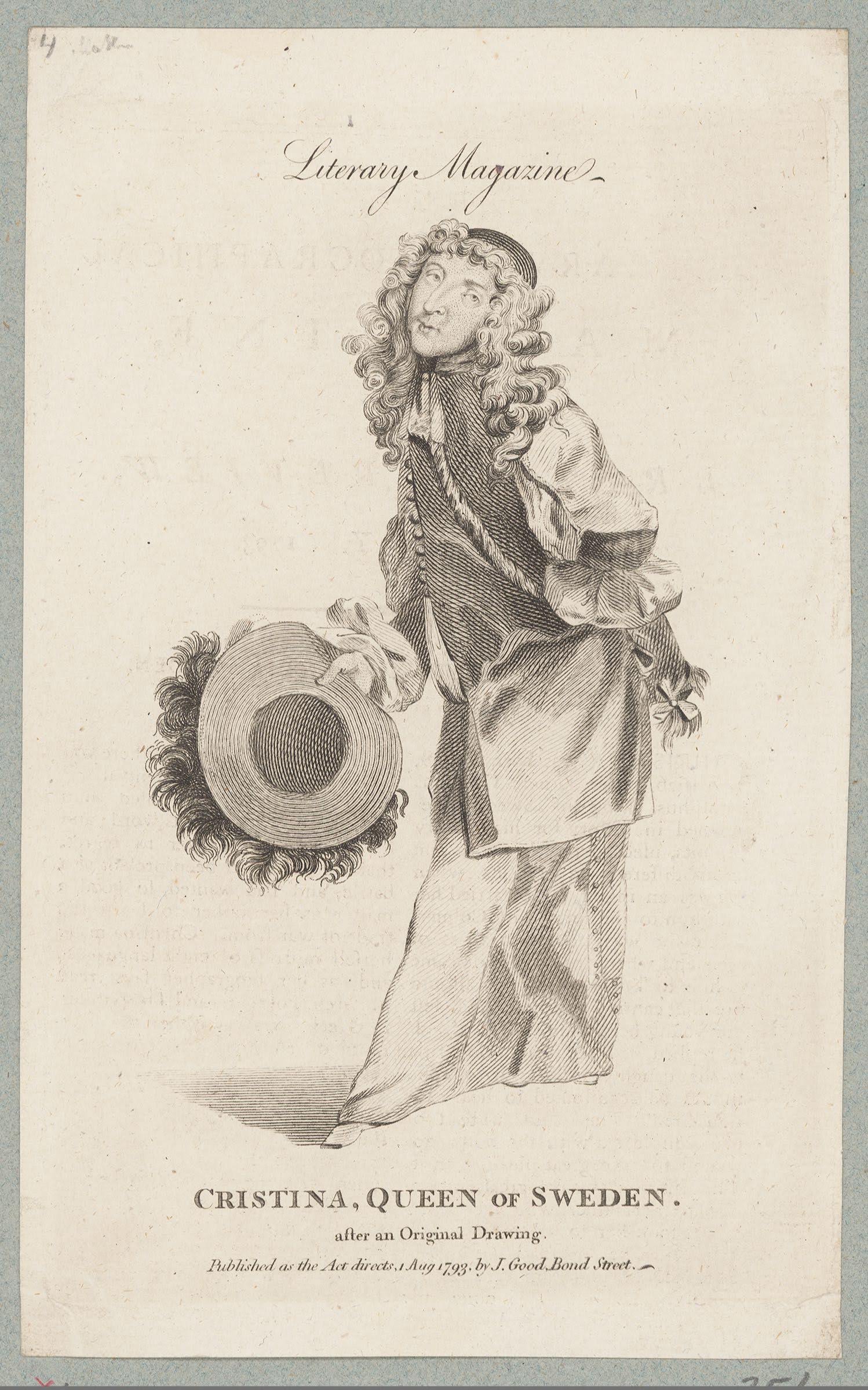
Showing posts with label Kristina's disregard and incomprehension of social norms and rules. Show all posts

Thursday, October 30, 2025

Corrado Ricci on Kristina's life in Italy, part 3

Sources:

Cristina di Svezia in Italia, article written by Corrado Ricci for Nuova antologia di scienze, lettere ed arti, volume 41 (125), pages 29 to 31, published by the Direction of Nuova antologia, 1892; original at the Bavarian State Library


Roma, visioni e figure: con 29 illustrazioni, pages 142 to 144, by Corrado Ricci, 1925; original at Cornell University


The article:

Intanto ad Alessandro VII crescevano i sopraccapi e i fastidi per la sua convertita che pretendeva costantemente onoranze eccessive, superiori alla prammatica e al cerimoniale in uso. Non rinunziò ella a visitare il Campidoglio perchè i Senatori si rifiutarono di riceverla a capo scoperto accampando che appunto a capo coperto i loro predecessori avevano ricevuto un imperatore come Carlo V? Ed è veramente curioso ch'ella persistisse ognor più a manifestare pretese su pretese, quando poi a sua volta mancava alle norme più semplici della devozione frequentando gli altari senza il rosario e senza libri di preghiera.

Ma le pratiche religiose erano una fatica noiosissima per lei che vera passione dimostrava solo per la sua Accademia, per le commedie e i drammi musicali. S'era messa sino a studiar canto con sommo dispiacere del papa. — Ma ben altre pillole il povero vecchio doveva ingoiare! — Da un dispetto, da un capriccio di lei potevano nascere danni sensibili alla religione, proprio quando la sua conversione cominciava a produrre utili risultati, avendola imitata il marchese di Sultzbach. Alla corte pontificia si sopportava tutto con santa pazienza, e s'andava anche coi piedi di piombo nel farla avvertita dei danni cui poteva andare incontro.

Ovvio però era l'accorgersi sin da principio che Cristina con le sue stranezze avrebbe finito per divenire la favola di Roma e perdere il prestigio dapprima esercitato sul pubblico; il quale, una sera, al teatro Barberini, dopo averla aspettata lungamente, perchè la rappresentazione potesse cominciare, al suo apparire l'accolse con urli e fischi. Cristina s'inchinò ringraziando, atto di sprezzante confidenza non degno certo d'una sovrana! E peggio fece ancora quando, ad un simile dispetto del pubblico, per un nuovo indugio, rispose fischiando da parte sua mefistofelicamente.

La plebe cessò allora di rispettarla. Al Corso le rivolse motti poco puliti cui rispose ridendo. Ai rimproveri, invece, che le venivano dall'alto, sino dal pontefice, pareva attendesse compunta, ma due minuti dopo, data una scrollatina di spalle, badava a fare i comodi suoi, fino a costringere il pontefice ad aspettarla in una chiesa dove non si recò che quando lo seppe partito!

Nella scelta del confidente religioso ella aveva seguìto fini criteri — diremo così — d'estetica! Il cardinal Decio Azzolini da Fermo non era soltanto un ingegno pronto e vivace, un parlatore brillante, ma anche un magnifico uomo, celebrato e favorito dalle dame. L'origine della conoscenza sua con Cristina si pretendeva risalisse ad una galanteria. Volendo colei discendere dalla carrozza presso S. Luigi dei Francesi e non sapendo dove porre il piede, tanto la via era limacciosa, egli, poco lontano, accorse, si levò la mantellina, la stese sul fango, e la regina passò. Falso o vero, il fatto — in sè ben poco importante — resterebbe a provare che l'Azzolini passava per un uomo galante. L'epigramma infatti del signor di Coulanges è assai più maligno che la storiella del mantello.

«Mais Azolin dans Rome
sceut charmer ses ennemis [sic].
Elle eût sans ce grand homme
passé des tristes nuits.»

L'autorità dell'Azzolini sull'animo di Cristina era tale che lo stesso pontefice si serviva di lui per intermediario quando voleva farlo sapere utili consigli. Invece, com'era a prevedersi, il cardinale le suggeriva le scuse e la tattica per avere soccorsi, consigliandole nei casi gravi a minacciar di rimpatriare; minaccia che faceva subito Alessandro arrendevole. Prometteva poi di vivere sobria, rassegnata e obbediente, e, promettendo soltanto, spillava danari al Papa quando già l'erario era tormentato dalla siccità. Ottenuto quanto voleva, si ribellava, e ad Alessandro, che la consigliava di ritirarsi, durante la peste, in un monastero, rispondeva di non esser nata per vivere fra quattro mura e di voler morire sul campo di battaglia. Il Provana soggiungeva ingenuamente: «Io non so che guerra voglia esser questa!» mentre il suo dubbio aveva un'efficace risposta in tutta la condotta di Cristina. La quale invece si preparava alla partenza e per mettere insieme quattrini impegnava i gioielli e vendeva malamente carrozze e cavalli.

Se n'andò una sera di luglio, e il riguardo del contagio non fu che la scusa per giustificare il viaggio che voleva fare in Francia ed in Germania. Andò fino a Civitavecchia a cavallo, accompagnata da parecchi cardinali e provvigionata dal Papa. «Aveva indosso» — dice il Claretta — «un giustacuore, una gala di trina, una sottana di colore sul bigio, solo a metà gamba; una ciarpa a traverso la vita; calze e scarpe bianche con rosetta nera, ed in testa una parrucca incipriata». Tutt'insieme, una bella caricatura!

English translation (my own):

In the meantime, Alexander VII's annoyances grew over his convert, who constantly demanded excessive honours, exceeding customary standards and ceremonial. Did she not give up visiting the Capitoline Hill because the Senators refused to receive her bareheaded, arguing that their predecessors had received an emperor like Charles V with their heads covered? And it is truly curious that she persisted in making ever greater demands when, in turn, she herself violated the simplest norms of devotion by frequenting altars without a rosary and without prayer books.

But religious practices were a very tedious chore for her, and she showed true passion only for her Academy, for comedies and musical dramas. She had even taken to studying singing, much to the Pope's displeasure. — But the poor old man had to swallow far different pills! — A single outburst, a whim on her part, could cause significant damage to religion, just when her conversion was beginning to produce useful results, as the Marquis of Sulzbach had imitated her. At the pontifical court, everything was endured with saintly patience, and they even proceeded with caution in warning her of the harm she might incur.

It was obvious, however, from the outset that Kristina, with her eccentricities, would eventually become the talk of Rome and lose the prestige she had initially wielded over the public. One evening, at the Teatro Barberini, the audience, after having waited a long time for her in order to begin the performance, greeted her with hoots and whistles upon her appearance. Kristina bowed in thanks, an act of contemptuous confidence certainly unworthy of a sovereign! And it was even worse when, in response to the audience's similar displeasure, she responded by Mephistophelianly whistling at herself for another delay.

The common people then ceased to respect her. At the Corso, they addressed her with unsavory remarks, to which she responded by laughing. She seemed to await the rebukes coming from above, even from the Pontiff, with composure; but two minutes later, with a shrug, she was going about her business, even forcing the Pontiff to wait for her in a church, where she did not show up until she learned he had left!

In choosing her religious confidant, she had followed fine — so to speak — aesthetic criteria! Cardinal Decio Azzolino of Fermo was not only a quick and lively genius, a brilliant speaker, but also a magnificent man, celebrated and favoured by the ladies. The origin of his acquaintance with Kristina was said to be based on gallantry. When she wanted to alight from the carriage near San Luigi dei Francesi and, unsure where to put her foot because the path was so muddy, he ran up nearby, took off his cloak, spread it on the mud, and the Queen passed by. True or false, the fact — in itself of little importance — would prove that Azzolino was considered a gallant man. Indeed, Monsieur de Coulanges's epigram is far more malicious than the story of the cloak.

"Mais Azolin dans Rome
sceut charmer ses ennemis [sic].
Elle eût sans ce grand homme
passé des tristes nuits."

["But Azzolino in Rome
knew how to charm her enemies [sic];
she had without this great man
passed sad nights."]

Azzolino's influence over Kristina's mind was such that the Pontiff himself used him as an intermediary when he wanted to pass on useful advice. Instead, as foreseen, the Cardinal suggested excuses and tactics for obtaining succour, advising her, in serious cases, to threaten repatriation — a threat that immediately made Alexander compliant. She then promised to live soberly, resignedly and obediently, and, by promising nothing more, she extorted money from the Pope when the treasury was already racked by drought. Having obtained what she wanted, she rebelled, and when Alexander advised her to retire to a monastery during the plague, she replied that she was not born to live within four walls and wanted to die on the battlefield. Provana naively added: "I don't know what kind of war this is!" while his doubts were effectively answered in Kristina's entire conduct. She, however, was preparing to leave and, to raise money, she pawned her jewels and sold carriages and horses at a low price.

She left one evening in July, and concern about the contagion was merely an excuse to justify the journey she wanted to make to France and Germany. She rode to Civitavecchia on horseback, accompanied by several cardinals and provisioned by the Pope. "She was wearing", says Claretta, "a justaucorps, a lace ruche, a greyish skirt that reached only mid-calf; a scarf around her waist; white stockings and shoes with a black rosette, and a powdered wig on her head." All in all, a fine caricature!


Above: Kristina.


Above: Cardinal Decio Azzolino.


Above: Corrado Ricci, painted by Ettore Tito in 1913.

Monday, September 22, 2025

Carl Grimberg's article on Kristina's life, in "The American-Scandinavian Review", September 1927

Source:

Romances of Swedish Queens: Kristina, Daughter of Gustavus Adolphus, article written by Carl Grimberg for The American-Scandinavian Review, volume 15, pages 523/525 to 535 (Number 9, September, 1927), published by the American-Scandinavian Foundation, 1927; original at the University of Michigan


Above: Carl Grimberg.

"There are few characters in history more fascinating than Queen Kristina, Gustavus Adolphus's daughter who renounced her father's crown and his faith. Her story is the second in four "Romances of Swedish Queens" which the distinguished Swedish historian, CARL GRIMBERG, is writing for the REVIEW."

The account:

Romances of Swedish Queens:
Kristina, Daughter of Gustavus Adolphus
By CARL GRIMBERG
NEVER has a man been more profoundly worshipped by a woman than was the great hero-king Gustavus II Adolphus by his beautiful spouse, Maria Eleonora of Brandenburg. It was ardent love at first sight. The very first time the two young people saw each other, according to a spectator, "the princess could never take her eyes from His Majesty." Nay, not even death seemed capable of separating Maria Eleonora from her beloved Gustav. On receiving the sorrowful message that he had offered up his life on the battlefield of Lützen for the cause of Protestantism, she hurried to his bier; and day and night she could not be separated from his remains. In fact, two days after his body had been deposited in Riddarholmskyrkan, she wanted to descend into the vault and have the coffin opened.

It is indeed a heartrending thing to see a love so all-devouring, a passion so blind, that it cannot be checked even by the dread hand of death. And yet this woman, who lived and breathed only by the memory of her happy love, was no withered old woman, but young and radiantly beautiful still. At the death of Gustavus Adolphus she was not quite thirty-three years old. In a dark, shut-in chamber, lighted only by the dull gleam of funeral candles, she sat day in and day out, clad in deepest mourning, with her only child, little Kristina, who later, on becoming of age, was to succeed her great father on the throne. The little girl was now Maria Eleonora's only comfort, for she seemed to see in her daughter the image of her departed mate. But what a life for the lively little seven-year-old with the big questioning eyes to sit closeted thus with the hysterical woman who only wept and mourned!

If the little girl who later was to govern the realm of Sweden — then one of the great powers of Europe — was not to be entirely ruined, she must be separated in time from her mother, who moreover did all she could to arouse in the child antipathy toward Sweden. The separation was effected, in spite of the violent protests of the mother, who in her desperation even contemplated suicide. Finally she fled the country.

Little Kristina came under the guidance of her sensible and very excellent aunt.

It was no easy task to take charge of this child prodigy — for a prodigy she was already. At her very arrival to this earth she came as a surprise. The astrologists had prophesied that the ardent desire of Gustavus Adolphus and Maria Eleonora for a son would be fulfilled. When a swarthy little brat came to the world — "brown as a Moor", in Kristina's own words — and greeted those standing by with an uncommonly vigorous cry, a real boy's howl, everybody thought at first that the soothsayers had spoken the truth.

Then came the disappointment! But papa laughed it off. "She is going to be very clever", he remarked, "for she fooled us all." For that matter, it soon became evident that the little one was a regular tomboy. In her autobiography, written in her later years, she says that she had always harbored "an invincible dislike for all that was feminine in word and action"; and that dislike lasted all her life. As often as possible she sought masculine company; but what attracted her to men was, according to her own explanation, not so much that they were men as that they were — not women.

Gustavus Adolphus was delighted with every indication of boyishness in his little girl. After all, he said, she was a warrior's daughter and ought to show it. That she had inherited her father's intelligence as well as courage soon became evident. With her large, eager eyes she literally drank in knowledge of every kind. Learning a new language like Greek she called a diversion for idle moments, about like playing chess, and never could her appetite for history, and politics be sated. For hours she could sit and discuss them with her teachers. A precocious and unusually gifted child who knew what she wanted — such is the impression one receives of the future regent of Sweden.

Kristina, however, was not only the highly gifted and strong-willed daughter of Gustavus Adolphus; she possessed also a heritage from her poor mother, so capricious and eccentric.

The most famous delineation of Kristina's appearance and manner is by the French envoy Chanut, who describes, in a letter to his government early in 1648, the impression made by the twenty-one-year-old queen on an observer who was both penetrating and enthusiastic. He says[,] among other things: "The first time you see her she does not awaken the same admiration as on closer observation. A single portrait is not sufficient to give an idea of her appearance; her face changes with her thoughts and emotions so that you scarcely recognize her from one moment to the other. But usually she appears thoughtful, and however her expression varies, she always retains a trace of the sunny and agreeable. At times her voice becomes more powerful than is characteristic of her sex. She attaches no importance to dress: in fifteen minutes she is dressed, and for everyday a comb and a bit of ribbon constitute her only head-dress. Yet her carelessly hanging hair is not unbecoming to her face, which she does not trouble to shield against rain or wind. While hunting she can sit on horseback for ten hours at a stretch; and there is no one in Sweden who can fell a leaping hare more surely. Neither cold nor heat bother her. Her food is simple and lacking in delicacies. She is chary of time and sleeps only five hours. She takes great pleasure in seeing learned men around her and hearing them treat difficult scientific problems. On such occasions she never expresses her opinion until all others have spoken, and then she does it well, with few words."

In our day, with the freer manners for women which have accompanied sports and comradeship between the sexes, Kristina would surely not have created such a sensation as in her own time. She would simply have been classified as a "modern sportswoman." But the thing which would have distinguished her in any age was her brilliant mind. Now, as in the age when she lived, the world would surely have reëchoed with admiration for the young girl who from 1644 governed independently that Northern land which her father had made a great power. Kristina herself enjoyed being famous, and her unusual endowment and thirst for knowledge showed her a way. Through valor at arms the Swedish nation had made itself a name in the world. Yet one thing remained; in the barren Swedish soil the finer flower of culture had not yet taken root. But why shouldn't it? Did it not seem as though Providence had appointed the great warrior's daughter as the guardian of science and art in the Northlands? A court in which the queen shone like a star in a constellation of European savants — that was an ambition worthy of the daughter of Gustavus Adolphus.

Scores of scientists, especially Frenchmen, accepted Kristina's invitation to Stockholm. They had left home and wife and child in order to behold the new goddess of wisdom on Sweden's throne, "the northern Minerva." For her sake they had been tossed about for weeks on a stormy sea in frail little ships, or shaken till they were bruised and tender on ungodly country roads. Indeed these children of the South even braved the dreaded cold of the Northlands in the blissful certainty that the queen of Sweden would richly reward all their trouble.

Towering above them all was the Frenchman Descartes, one of the greatest philosophers who have ever lived. After a long period of correspondence and persistent exhortation[,] Kristina succeeded in getting him to Stockholm, in the fall of 1649. He was no mouldy bookworm, this penetrating thinker with whom the queen of Sweden now found opportunity to discuss life's deepest problems. Descartes was an aristocrat, an experienced man of the world. He had been an officer, and enjoyed a reputation not only as a philosopher but also as a gallant. But surely no woman had so selfishly monopolized him as his royal admirer in Stockholm. At five o'clock in the morning he had to report in her library to instruct her and argue with her. Alas for him, who had assumed the comfortable habits of the man of the world! In the dark and chilly rooms of the Stockholm palace he shook with cold, and after four months he contracted pneumonia and died.

The young queen, however, had an eye not only for learning and genius in the opposite sex[,] but also for superficial excellencies. She had by nature a keen esthetic sense and loved to feast her eyes on what was beautiful and brilliant. Around her was a swarm of young nobles who had won her favor. The most celebrated was Count Magnus Gabriel De la Gardie, the son of General Jacob De la Gardie and beautiful Ebba Brahe, the first love of Gustavus Adolphus. He was beyond comparison the most handsome and cultured of the Swedish noblemen. Queen Kristina was overcome by his charm, and she made no secret of her liking; she showered him with unmerited distinctions. At the age of twenty-two he became Colonel of the Guards, and at the same time she placed him at the head of a brilliant embassage to Paris, which cost the poor Swedish nation a tidy sum of money.

It was even rumored that the queen contemplated the pampered favorite as her consort. Indeed[,] her very frank autobiography conveys the impression that the rumor was not without foundation, but pride restrained her from devoting herself to any man and subordinating herself to a husband. During the regency, when one of her guardians put the question of matrimony to her, the fifteen-year-old Kristina gave the cutting reply: "The person who can belong to herself should not belong to any one else." As for De la Gardie, his star was destined soon to pale. When the queen found that he was too cowardly to fight a duel, her admiration suddenly turned to disdain. In vain the pampered favorite sought to win back the heart of his queen. "Do not believe that I am angry with you", she wrote to him. "I assure you that I am not. The only feeling I can have for you henceforth is pity."

Discussing science and art and following up one brilliant court festivity with another are not the chief mission of a ruler, however, though Kristina seemed to think so. She soon turned a deaf ear to her more serious and tedious duties to the government. Yet this was a time of great opportunity in Sweden: difficult social problems craved solution, and only from the throne could help come. The nobility, the upper class of the realm, had become so powerful that it threatened to destroy the time-honored freedom of the Swedish peasantry. Sweden's constant quarrels with her neighbors had given caste to the warrior, and the deeds of prowess accomplished by leading men on the battlefields were rewarded, in accordance with the custom of the time, with investiture of lands. Year by year the earldoms and baronies and other tax-free estates increased, so that they finally embraced half the territory of the realm. When the land came into the possession of a nobleman, it became entirely or at least partially free from taxation to the Crown. The small farms were in danger of being swallowed up by manors, and the freedom of the peasantry was threatened. "We have heard", grumbled the peasantry at the Rigsdag [sic] of 1650, which was called to witness the queen's coronation, "that in other lands the peasant is a slave, and we fear that the same may befall us." The situation was aggravated by dearth and famine. Even in the most fertile provinces the people had to resort to bark bread. Many starved to death, and the roads were full of beggars.

To those who understood the lay of the land[,] it was very evident that the demands of the commoners could not long be ignored by the government. Kristina too realized it; but it is one thing to realize, and another to act. Far from trying to ameliorate conditions, Kristina made them worse from year to year. She created, on an average, one new nobleman each week, and in many cases the actual worth of the new-baked nobleman was highly disputable. The royal tailor may have been a very clever fellow in his trade, but it is doubtful whether his spirit had the heroic trend which would justify Her Majesty's cutting him a lion's shield with her own fair hand.

All the new earls and barone created by Kristina had to be provided with earldoms and baronies. The result was such a giving of lands that the queen finally could not keep track of which estates had been given away and which still belonged to the Crown.

At the same time[,] Kristina wasted quantities of money on court festivities, one more lavish than the other. Never before had Sweden seen anything to equal the splendor with which she celebrated her coronation. It was a dazzling spectacle to behold — all the land could offer of splendor and magnificence started in procession from the Stockholm palace toward Storkyrkan. But all the rest was eclipsed by the Queen of Sweden in her carriage de luxe, drawn by six snow-white steeds, silvershod, caparisoned with red velvet embroidered in gold and wearing tufts of pure white plumes on their heads. She was resplendent in a gown almost totally covered with gold, pearls, and jewels. Behind her carriage came her favorite white horse, whose mane and tail almost swept the ground. He wore a saddle richly embroidered in silver and gold, and about his silvershod hoofs was a rattling of gold chains.

After the coronation came a series of banquets and other diversions for the poor people. On the main market-place an ox roasted whole, a "coronation" ox, as it was called, was served to the people, and wine flowed from several fountains.

In the course of these festivities, the queen had found it necessary to order that the beggars who, because of the famine, had swarmed into Stockholm be led away, so that they would not "fill up the streets, to our dishonor and that of the Crown, especially considering the foreigners who have come to the city."

And now for some statistics! On Kristina's ascending the throne, three percent of the total income of the realm was consumed by court expenses. During her last year the figure had risen to twenty percent! In our day the Swedish court requires about one-third of one percent of the state revenues.

Kristina realized fully that in the long run the state finances of Sweden could not be handled in this way; but it was too tedious a task to start economic and social reforms. Her capricious and impulsive nature had long since tired of the daily grind of government worries. Once[,] when two secretaries came in with a pile of government negotiations to be signed by the queen, she greeted them with the kind words that it was "just as much fun for her to see them enter as if the devil himself had come for a visit." With the ruthless determination characteristic of Kristina, she soon found a way out of the difficulty: she would renounce the crown and leave Sweden forever. Free! She wished to be free, free from all duties, free from all bonds! She had never harbored any warm sentiments for her fatherland, and as little had she ever felt any obligation to work for the welfare of the loyal though poverty-stricken people of Gustavus Adolphus [sic], for her insight into the popular character had never penetrated beneath the rather rough surface.

Kristina's whim to leave Sweden had other reasons than those enumerated. The daughter of Gustavus Adolphus had secretly become a Catholic. In her heart of hearts she had never been a Lutheran — so she claimed. She found the Lutheran church service monotonous; she longed for the mystic ceremonies which gave atmosphere to the worship in the Catholic churches. Her independent nature from the beginning had resisted all attempts of well-meaning educators to implant in her a faith in the excellency of Protestantism. Yet her restless, doubting heart felt an actual need of making reason a captive to faith, faith in the infallibility of the pope and all the dogmas incidental to it. Irreconcilable elements united in one human soul!

Kristina awaited with impatience the time when she could resign her queenship in order to be a human being. In the lands of the South she would live as a queen in the realm of genius, surrounded by the creations of art and the foremost poets and scholars of the age. All the honor she could win as the queen of Sweden was already hers. Her life's greatest triumph would now be this: at the acme of her power and glory, still young and fêted, she would voluntarily lay down the crown.

One reason for Kristina's resolution to abdicate was her distaste for giving the world a successor of her own flesh and blood. Her feeling toward matrimony was, as we have seen, one of decided antipathy. Multitudes of princes sought her hand, but none succeeded in winning her. Of no avail were the pleas of her subjects that she should marry. And "woman's will is God's will."

When the Riksdag convened in Uppsala in 1654, Kristina set in motion her plans to abdicate. She appeared in person before her people and announced her decision. When she had assured herself of a very considerable annual maintenance, consisting of the revenues from several Swedish provinces, the formal abdication took place in the hall of state in Uppsala castle. In the presence of the councillors and Estates of the Realm she laid down the crown, the apple, and the sceptre, and thereupon spoke "so gently and freely to those assembled that she moved many an honest man to tears", says an eyewitness. "Beautiful as an angel she stood there in a white robe."

In an ecstasy of happiness and freedom she left Sweden. Her goal was Rome, the eternal city. On the way thither she met an envoy from the pope in Innsbruck in the Tyrol, and before him, in the castle chapel, she publicly foreswore the faith for which her father had died, and expressed her conviction that no one can achieve salvation outside the Catholic church. "All wept; she alone shed no tear", says a spectator. Everywhere the Catholics rejoiced that the daughter of the heretic king had come to a realization of the truth and become the obedient child of his holiness the pope; and[,] hailed as a victor, she made her entrance in Rome, mounted on a snow-white horse and escorted by a brilliant cortège.

Kristina's first weeks in Rome were a dance on roses. The pope, the cardinals, and the society people of Rome took pains to show their most agreeable side to this most recent acquisition of the Roman church. But the first intoxication passed, and Kristina was to learn that fortune is not constant, even under the sunny skies of Italy. First the pope showed that he was not entirely satisfied with her. He had expected to see a crowned saint with the fragrance of holiness about her — a convert who spent her time in long prayers and good works, and was an example to be followed. Instead he found a woman uncommonly free in speech and bearing, who smiled and jested during the church services and who — Oh, height of impropriety! — turned the heads of the cardinals.

It was not only the pope who showed a bit of acid in his sweetness; the respect for the queen began to decrease here and there when it became noticeable that she was sometimes short of cash. "The Italians do not like converts without money", as the English ambassador in Livorno once said.

In her difficulties, however, Kristina found a helper and friend, faithful unto death: Cardinal Azzolino, who became a profound influence in her life. Azzolino's appearance was both forceful and pleasing, and his quick intelligence and high culture were to Kristina's taste. A very interesting glimpse into the relations between him and the ex-queen is gained by a study of the still existing letters of Kristina and the cardinal. This woman, who pours out her soul to her friend in complete sincerity, was very different from the queen who with bold courage defied the whole world. In these letters, intended for no eye but his, her womanliness comes to light. The will of the beloved has become her law, and without him life holds no value. She, the proudest of women, exclaims: "In relation to me you are omnipotent, and however you choose to treat me, I shall never complain." It is certain that, if Kristina ever gave herself wholly to any man, it was to Azzolino.

Kristina had expected to find in the eternal city the great peace and happiness. Now she had learned by experience that neither in the north nor in the south is peace to be found by a celebrity-hunter. Kristina wished to be independent of her fellow-men, but could not; but worse than that, she could not escape her own capricious self, which never allowed her a feeling of complete contentment; which drove her, throughout her whole life, to chase after phantoms. Hardly had she become settled in Rome when she appeared at the court in Paris. There she created a huge sensation, because of her eccentric appearance as well as her genius. People were amazed at her masculine way of flinging herself into chairs and throwing her legs over the arms of chairs in the presence of the king and the entire court. The French queen, Anne of Austria, vowed that she had never been so completely astonished. She had heard that "the travelling queen" was not like other people, but had never imagined anything quite so different. Yet for all her oddities, she could not help liking Kristina.

The following year [1657] she suddenly appeared again at the French court. While she was sojourning at the beautiful pleasure castle of Fontainebleau outside of Paris, there happened a sensational occurrence which has smirched her reputation. By order of the ex-queen her chief house-steward, the Italian Marquis of Monaldesco, was killed. Legend has spun around this deed the motive of love and jealousy, and Alexandre Dumas has built on this legend his treatment of the drama at Fontainebleau, however without any basis in reality. The true motive for the execution or the murder — whichever we should call it — was that Monaldesco for money had betrayed an important political confidence.

Her French visits were connected with plans, suddenly born in this restless head, to gain by intrigue the crown of the kingdom of Naples. In 1660, when her successor on Sweden's throne suddenly died, she could not forbear starting directly for Stockholm to try to obtain a new right to the crown; but her former subjects were now quite cool toward the adventuress from the pope's city.

One remark made by her during this visit deserves to be rescued from oblivion. When the eighty-seven-year-old archbishop, heading a delegation of ministers, came and admonished her to give up her erroneous religion and lamented "the pope's evil plots against our souls", Kristina retorted scornfully: "Good gentlemen, I know the pope better than you: he wouldn't give four dollars for all your souls together." Despite the failure of her trip to the homeland, however, Kristina visited it again in 1667, this time with still more ignominious results. The Swedish government gave her to understand plainly that the visit was not desired, and in her vexation she turned back when half-way to Stockholm. Shortly thereafter she took it into her head to seek the vacant throne of Poland. What attracted her was the suspense in playing for a throne rather than the throne itself — which she did not win in the end, for that matter.

La regina nomada, the travelling queen, had now become one of the curiosities of Rome. There she sat in Palazzo Riario, which she had changed to a museum of exquisite paintings, statues, books, and manuscripts, most of which she had brought with her from the royal palaces in her impoverished native land. With the years, she had become a fat little old woman with a double chin adorned with long, coarse hairs, an enormous eagle nose under bushy eyebrows, a protruding underlip and clipped hair, sprinkled with gray. But the big blue eyes still retained their fire. She was not forgotten by the good Romans in her old age; she saw to that by providing constant quarrels with the pope to liven up her existence. Once his holiness dismissed such a dispute with a shrug of the shoulders and the pertinent remark: "E donna"— she is a woman.

The only change in her life which she anticipated calmly and quietly was the greatest and last which awaits all. She had always declared that she did not fear death, and when she stood face to face with it, she showed that she had spoken the truth.

On the morning of April 19, 1689, she quietly drew her last breath, at the age of sixty-two. Her restless and storm-tossed life was ended. Her last hours were sweetened by the presence of Azzolino, who, though attacked by illness himself, watched day and night by her bedside. Under the crimson mantle of the cardinal beat a heart which mourned her, after all.

With great pomp and ceremony she was interred in St. Peter's cathedral, where her tomb constitutes a permanent reminder of the greatest triumph of Jesuitism, the conversion of the great heretic king's daughter.

"E donna" — those words which were received by Kristina as an unpardonable insult nevertheless explain better than anything else her restless, fluttering career. But what is the reason, we finally ask, for the depressing feeling of desolation, of meaningless emptiness, which results from a contemplation of Kristina's life and destiny? Why must we always see happiness just escaping this brilliant personality? The answer is that true happiness is absolutely unknown to the person who lives in constant concern for his own ego. All work for personal development becomes meaningless if the new powers developing within are not used in work for the happiness of others. Herein lies one of the great secrets of civilized community: no one may break the law of interdependence. Only by working at a life mission can any one find true happiness.

This life mission Kristina never found. Hence her great qualities never became the blessing which they might have become to her fellowmen; and consequently they never became a blessing to her.

Note: Palazzo Riario is the old name for the Palazzo Corsini alla Lungara.

Sunday, August 31, 2025

Anonymous biography of Kristina in "Eccentric Biography; or, Memoirs of Remarkable Female Characters, Ancient and Modern", year 1803, part 11

Source:

Eccentric Biography; or, Memoirs of Remarkable Female Characters, Ancient and Modern, pages 97 to 99, by anonymous author, 1803; original at The British Library


The biography:

... The inconstancy of Christina's temper appeared from her going perpetually from place to place; from Brussels she went to Rome; from Rome to France, and from France she returned to Rome again; after this she went to Sweden, where she was not very well received; from Sweden to Hamburg, where she continued a year, and then went again to Rome; from Rome she returned to Hamburg, and again to Sweden, where she was received still worse than before, upon which she went back to Hamburg, and from Hamburg again to Rome; she intended another journey to Sweden, but it did not take place any more than an expedition to England, where Cromwell did not seem well disposed to receive her; and after many wanderings, and many purposes of wandering still more, she at last died at Rome. It must be acknowledged, that her journeys to Sweden had a motive of necessity, for her appointments were very ill paid, though the States often confirmed them after her abdication; but to other places she was led merely by a roving disposition, and, what is more to her discredit, she always disturbed the quiet of every place she came into, by exacting greater deference to her rank, as queen, than she had a right to expect, by the total nonconformity to the customs of the place, and by continually exciting and fomenting intrigues of state. She was indeed always too busy, even when she was upon the throne, for there was no event in Europe in which she was not ambitious of acting a principle part. During the troubles in France, by the faction called the Fronde, she wrote with great eagerness to all the interested parties, officiously offering her mediation to reconcile their interests, and calm their passions, the secret springs of which it was impossible she should know; this was first thought a dangerous, and afterwards a ridiculous behaviour. During her residence in France, she gave universal disgust, not only by violating all the customs of the country, but by practising others directly opposite; she treated the ladies of the court with the greatest rudeness and contempt; when they came to embrace her, she being in a man's habit, cried out, 'What a strange eagerness have these women to kiss me! is it because I look like a man?' But, though she ridiculed the manners of the French court, she was very solicitous to enter into its intrigues. Lewis the XIVth, then very young, was enamoured of Mademoiselle de Mancini, niece to Cardinal Mazarine; Christina flattered their passion, and offered her service: 'I would fain be your confidant', said she; 'if you love, you must marry.' The expressions constantly used by Christina, in her letters, with respect to those with whom she was offended, were exceedingly harsh; for she scarce ever signified her displeasure without threat[e]ning the life of the offender. 'If you fail in your duty', said she to her secretary (whom she sent to Stockholm after her abdication) 'not all the powers of the king of Sweden shall save your life, though you should take shelter in his arms.' In the affair of the Franchises, the pretended rights of which she asserted with great haughtiness, she wrote thus to the pope's officers: 'Take my word, that those whom you have condemned to die, shall, if it please God, live some time longer, and, if it happens that they die a violent death, be assured they shall not die alone.' A musician having quitted her service for that of the duke of Savoy, she was so transported with rage as to disgrace herself by these words, in a letter written with her own hand: 'He lives only for me; and, if he does not sing for me, he shall not sing long for any body. — It is his duty to live only in my service; and, if he does not, he shall sorely repent it.' Bayle was also threatened very severely, for having said that the letter which Christina wrote, upon the revocation of the edict of Nantes, was a remain of protestantism: but he made his peace by apologies and submission. ...


Above: Kristina.

Note: embrace = kiss.

Sunday, March 26, 2023

Philip Zoete van Laeke's diary entry of February 23/March 5 (New Style), 1658

Source:

Journal d'un voyage à Paris en 1657-1658, pages 427 to 428, by Philip Zoete van Laeke, published by A. P. Faugère, 1862
The diary entry:

Le 5e, qui estoit le mardy-gras, nous fusmes, de mesme que l'année passée, tous pourmener au cours Saint-Antoine pour voir finir les folies du carnaval; mais il y avoit une si horrible confusion de carrosses, et de plus de trois mille, que nous ne pusmes iamais gaigner la porte. Nous vismes pourtant quantité de masques tant à pied qu'en carrosse et à cheval, qui estoient assez gentiment aiustés. L'apres-soupée nous voulusmes courir les bals, mais comme nous estions sur le Pont-Neuf, une soupante se cassa au carrosse et nous empescha d'executer le dessein que nous avions pris. Ce soir-là toute la Cour se partagea par bandes, et la Reyne, le Roy, Monsieur, Mademoiselle et nostre reyne Christine furent chacun à part courre les bals. Son Eminence, qui a les gouttes et qui de l'autre costé n'a guere l'esprit libre depuis que le mareschal d'Hocquincourt s'est ietté dans Hesdin, garda le Louvre. On ne sçait pourtant s'il est veritablement malade: il y a bien de monde qui dit qu'il feint de l'estre pour obliger la reyne de Suede à luy quitter au plus tost son apartement, le voyant ainsi reduict à l'estroict et incommodé. Mais elle ne s'en esmeut guere, et on ne croit pas qu'elle parte sitost. Cependant elle desole la Cour par ses façons de faire: quand l'envie l'en prend, elle descend à la chambre du Roy, va à celle de la Reyne et à celles de Monsieur et de Son Eminence sans les en faire advertir et à des heures si incommodes qu'ils en sont à la gesne. Elle les fait veiller toute la nuict, et comme elle dort peu ou point, elle se leve de si bon matin qu'elle ne leur donne pas le temps de dormir.

With modernised spelling:

Le 5e, qui était le mardi gras, nous fêmes, de même que l'année passée, tous pourmener au cours Saint-Antoine pour voir finir les folies du Carnaval; mais il y avait une si horrible confusion de carrosses, et de plus de trois mille, que nous ne pûmes jamais gagner la porte. Nous vîmes pourtant quantité de masques tant à pied qu'en carrosse et à cheval, qui étaient assez gentiment ajustés. L'après-soupée, nous voulûmes courir les bals, mais comme nous étions sur le Pont-Neuf, une soupante se cassa au carrosse et nous empêcha d'exécuter le dessein que nous avions pris.

Ce soir-là, toute la Cour se partagea par bandes, et la reine, le roi, Monsieur, Mademoiselle et notre reine Christine furent chacun à part courre les bals. Son Éminence, qui a les gouttes et qui de l'autre côté n'a guère l'esprit libre depuis que le maréchal d'Hocquincourt s'est jetté dans Hesdin, garda le Louvre. On ne sait pourtant s'il est véritablement malade; il y a bien de monde qui dit qu'il feint de l'être pour obliger la reine de Suède à lui quitter au plus tôt son appartement, le voyant ainsi reduit à l'étroit et incommodé. Mais elle ne s'en émut guère, et on ne croit pas qu'elle parte si tôt.

Cependant, elle désole la Cour par ses façons de faire: quand l'envie l'en prend, elle descend à la chambre du roi, va à celle de la reine et à celles de Monsieur et de Son Éminence sans les en faire avertir et à des heures si incommodes qu'ils en sont à la gêne. Elle les fait veiller toute la nuit, et comme elle dort peu ou point, elle se lève de si bon matin qu'elle ne leur donne pas le temps de dormir.

Swedish translation (my own):

Den 5, som var fettisdag, gick vi alla på en promenad, som förra året, till Cours Saint-Antoine för att se karnevalens dårskap ta slut; men det var en sådan förfärlig förvirring av vagnar och mer än tre tusen, att vi aldrig kunde nå porten. Vi såg dock ett antal masker, både till fots och i vagnar och till häst, som var fint anpassade. På sena kvällen ville vi gå till balerna, men när vi var på Pont-Neuf bröt en soupante i vagnen och hindrade oss från att genomföra den avsikt vi hade tagit.

Den kvällen delade sig hela hovet i band, och drottningen, konungen, monsieur, Mademoiselle och vår drottning Kristina var åtskilda vid balerna. Hans Eminens, som har gikt och som på andra sidan knappast haft en fri ande sedan marskalken d'Hocquincourt kastade sig in i Hesdin, vaktade Louvren. Man vet dock inte om han verkligen är sjuk; det finns många som säger att han låtsas vara det för att tvinga Sveriges drottning att så snart som möjligt lämna sitt appartemang och se sig därmed reducerad till trånga förhållanden och besvärad. Men hon blev knappast rörd av det, och man tror inte att hon beger sig så snart.

Emellertid plågar hon hovet genom sina sätt att göra saker: när lusten tar henne, går hon ner till konungens kammare, går till drottningens och till monsieurs och Hans Eminens' utan att låta dem veta det och på timmar så obekvämt att det är en genans. Hon håller dem vakna hela natten, och eftersom hon sover lite eller inte alls går hon upp så tidigt på morgonen att hon inte ger dem tid att sova.

English translation (my own):

On the 5th, which was Mardi Gras, we all went for a walk, like last year, to the Cours Saint-Antoine to see the follies of Carnaval come to an end; but there was such a horrible confusion of carriages, and more than three thousand, that we could never reach the gate. We saw, however, a number of masks, both on foot and in carriages and on horseback, which were nicely adjusted. In the late evening, we wanted to go to the balls, but as we were on the Pont-Neuf, a soupante broke in the carriage and prevented us from carrying out the plan we had taken.

That evening the whole Court divided into bands, and the Queen, the King, Monsieur, Mademoiselle, and our Queen Kristina were each apart at the balls. His Eminence, who has gouts and who on the other side has hardly had a free spirit since Marshal d'Hocquincourt threw himself into Hesdin, guarded the Louvre. One does not know, however, if he is truly ill; there are many people who say that he pretends to be so to oblige the Queen of Sweden to leave his apartment as soon as possible, seeing himself thus reduced to cramped conditions and inconvenienced. But she was hardly moved by it, and one does not believe that she is leaving so soon.

In the meantime, she distresses the court by her ways of doing things: when the fancy takes her, she goes down to the King's chamber, goes to that of the Queen and to those of Monsieur and His Eminence without letting them know and at hours so inconvenient that it is a discomfort. She keeps them up all night, and as she sleeps little or not at all, she gets up so early in the morning that she does not give them time to sleep.


Above: Kristina.

Saturday, January 21, 2023

Description of Kristina from an early posthumous biography, year 1697

Sources:

Histoire des intrigues galantes de la reine Christine de Suede: et de sa cour, pendant son sejour à Rome, pages 3 to 5, by Christian Gottfried Franckenstein, 1697
The history of the intrigues & gallantries of Christina, Queen of Sweden, and of her court whilst she was at Rome faithfully render'd into English from the French original, pages 13 to 15, translated by Philip Hollingworth, 1697 (1927 edition in second link)


Vi Christina med Guds nåde, page 49, by Py Sörman, 1942


Above: Kristina.

The description:

Christine Alexandre, a peut-être, été la Princesse de notre siecle qui a le plus imposé, & fait parler d'elle dans le monde: elle sçavoit si bien assortir un certain caractere de grandeur dans toute sa personne, que tout le monde en étoit charmé; son Esprit donnoit de l'admiration à ceux qui l'approfondissoient, mais certaines graces qui brilloient sur son visage, donnoient encore plus d'amour à ceux qui la consideroient. Il y avoit cependant plus d'agrément dans l'un que dans l'autre, mais toutes ses qualitez extraordinaires empéchoient de faire reflexion sur les defauts qu'il y avoit en sa personne. Elle étoit beaucoup voutée, pour ne pas dire presque bossuë, sa taille étoit mediocre & grossiere, cependant elle se regardoit comme dans un enbon point raisonnable, son teint étoit le plus beau du monde, elle avoit les yeux beaux & brillans, tous les traits delicats, les levres vermeilles, la bouche petite, les dents belles, le nez aquilin, la Gorge & les mains blanches quoiqu'elle ne se lavât jamais les mains, & le visage que dans de l'eau de fontaine. Outre tous ces agrémens de son sexe qui font une beauté dans son naturel, elle avoit encore plusieurs belles qualitez du nôtre, la hardiesse, & l'intrepidité, une parfaite connoissance de toutes choses, une grande dexterité à conduire les affaires importantes, & delicates, enfin elle avoit presque tout le merite des deux sexes; la beauté de son esprit, la facilité de son genie, la justesse de ses pensées, la delicatesse de ses expressions, en un mot cette memoire prodigieuse qui faisoit que le passé étoit devant ses yeux comme le present; tous ces rares talens dis-je, & toutes ces belles qualitez ebloüissoient tellement ceux qui l'approchoient, qu'ils étoient incapables de faire attention à autre chose quà celles qu'ils voyoient. Cependant ceux qui nese laissoient pas seduire si aisement, reconnoissoient que dans cet esprit tout transcendant & tout capable de grandes choses qu'il étoit, il y avoit des defauts considerables; elle aimoit les plaisirs, & ne gardoit gueres de mesures ni de bien seance en les prenant: on la Vuë s'abbaisser jusqu'à se familiariser avec plusieurs de ses Officiers; ses Domestiques qui la voyoient prendre toutes sortes de libertez avec tant de personnes de differens sexes, ont quelque fois douté du sien: ses favoris l'ont trouvée souvent legere, & inconstante, contrariante, & toujours pleine d'elle même, ce qui n'est pas supportable dans les Princes mêmes. ...

With modernised spelling:

Christine Alexandra a peut-être été la princesse de notre siècle qui a le plus imposé et fait parler d'elle dans le monde. Elle savait si bien assortir un certain caractère de grandeur dans toute sa personne que tout le monde en était charmé. Son esprit donnait de l'admiration à ceux qui l'approfondissaient, mais certaines grâces qui brillaient sur son visage donnaient encore plus d'amour à ceux qui la considéraient. Il y avait cependant plus d'agrément dans l'un que dans l'autre, mais toutes ses qualités extraordinaires empêchaient de faire réfléxion sur les défauts qu'il y avait en sa personne.

Elle était beaucoup voûtée, pour ne pas dire presque bossue. Sa taille était médiocre et grossière, cependant elle se regardait comme dans un en bon point raisonnable. Son teint était le plus beau du monde. Elle avait les yeux beaux et brillants, tous les traits délicats, les lèvres vermeilles, la bouche petite, les dents belles, le nez aquilin, la gorge et les mains blanches, quoiqu'elle ne se lavât jamais les mains; et le visage que dans de l'eau de fontaine.

Outre tous ces agréments de son sexe qui font une beauté dans son naturel, elle avait encore plusieurs belles qualités du nôtre: la hardiesse et l'intrépidité, une parfaite connaissance de toutes choses, une grande dextérité à conduire les affaires importantes et délicates. Enfin, elle avait presque tout le mérite des deux sexes. La beauté de son esprit, la facilité de son génie, la justesse de ses pensées, la délicatesse de ses expressions, en un mot, cette mémoire prodigieuse qui faisait que le passé était devant ses yeux comme le présent — tous ces rares talents, dis-je, et toutes ces belles qualités eblouissaient tellement ceux qui l'approchaient qu'ils étaient incapables de faire attention à autre chose qu'à celles qu'ils voyaient.

Cependant ceux qui ne se laissaient pas séduire si aisément reconnaissaient que dans cet esprit tout transcendant et tout capable de grandes choses qu'il était, il y avait des défauts considérables.

Elle aimait les plaisirs et ne gardait guère de mesures ni de bienséance en les prenant. On l'a vue s'abaisser jusqu'à se familiariser avec plusieurs de ses officiers. Ses domestiques, qui la voyaient prendre toutes sortes de libertés avec tant de personnes de différents sexes, ont quelquefois douté du sien. Ses favoris l'ont trouvée souvent légère et inconstante, contrariante et toujours pleine d'elle-même, ce qui n'est pas supportable dans les princes-mêmes. ...

Swedish translation (my own):

Kristina Alexandra var kanske vår sekels prinsessa som har påtvingat mest och fått folk att prata om henne över hela världen. Hon visste så väl hur hon skulle assortera en viss karaktär av storhet i hela sin person att alla charmerades av henne. Hennes espri gav beundran till dem som lärde sig förstå henne, men vissa gracer som lyste i hennes ansikte gav ännu mer kärlek till dem som såg på henne. Det fanns dock mer charm i den ena än i den andra, men alla hennes extraordinära egenskaper hindrade reflektion över de fel som fanns i hennes person.

Hon var väldigt krokig, för att inte säga nästan puckelryggig. Hennes figur var medioker och tjock, men hon såg sig själv som ganska rimlig. Hennes hy var den vackraste i världen. Hon hade vackra, glänsande ögon, alla drag ömtåliga, rubinröda läppar, en liten mun, vackra tänder, en kroknäsa och en vit hals och händer, fastän hon aldrig tvättade händerna; och hon tvättade bara sitt ansikte i fontänvatten.

Förutom alla de tjusningar av hennes kön, som gör en skönhet i hennes natur, hade hon fortfarande flera fina egenskaper hos vårt kön: djärvhet och orädsla, en fullkomlig kunskap om alla ting och en stor skicklighet i att sköta viktiga och ömtåliga affärer. Enfin, hon hade nästan alla förtjänster av båda könen. Skönheten i hennes sinne, faciliteten i hennes ingenium, noggrannheten i hennes tankar, ömheten i hennes uttryck, med ett ord, det vidunderliga minnet som fick det förflutna att verka som nuet framför hennes ögon — alla dessa sällsynta talanger, säger jag, och alla dessa vackra egenskaper bländade dem som närmade sig henne så mycket att de inte kunde uppmärksamma något annat än vad de såg.

Men de som inte lät sig förföra insåg så lätt att det i denna anda, så fullkomligt transcendent och kapabel till stora ting som den var, fanns avsevärda fel.

Hon älskade nöjen och iakttog lite återhållsamhet eller anständighet när hon tog dem. Hon sågs böja sig för att bekanta sig med flera av sina officerare. Hennes tjänare, som såg henne ta alla möjliga friheter med så många människor av olika kön, tvivlade ibland på hennes eget kön. Hennes favoriter fann henne ofta lättsinnad och inkonstant, störig och alltid full av sig själv, vilket inte är uthärdligt hos furstar själva. ...

English translation (by Hollingworth):

Christina Alexandra has perhaps been the Princess, who has most of all imposed on us, and made her self most talk'd of in the World. She knew so well to assert a certain Character of Greatness in her whole Personage that she charmed all Mankind. Her Wit caused Admiration in all who were able to comprehend it; and certain Graces sparkled in her Face, which caused Love in all that view'd them: Nevertheless she had more agreeableness in the one than the other; and her extraordinary Qualities hindred People from reflecting upon the real Defects of her Person. She was a little bent, not to say crooked: Her Stature was middle-sized, inclining to be fat; and yet she was at a reasonable stand as to that Point: Her Complexion was the finest in the World: Her Eyes were beautiful and sparkling; her Lips red; she had good Teeth, and an Aquiline Nose; her Neck and Hands white, tho' she never wash'd them in any thing but cold Water. Besides these Excellencies of her Sex, which made her a Beauty in her own Nature, she had some of the best Qualities of ours, such as Courage and Undauntedness, with an admirable knowledge of most things; a great dexterity in the Conduct of the weightiest Affairs, as also of the most curious. And in a word, she had almost all the choicest Qualifications of both Sexes. The greatness of her Wit, the facility of her Genius, the exactness of her Thoughts, the delicacy of her Expressions, and last of all a prodigious Memory, which made past things appear as present: All these rare Talents should I say, or rather all these extraordinary Qualities did so astonish all that approach'd her, that they were not capable of attending any other thing. And yet those who would not suffer themselves to be so easily led away without a nicer Inspection, could find considerable Faults in her, how great and transcendent soever her Wit were. She so much loved her Pleasure, that she observed no Measures in the taking of it, and would Debase her self so far as to be Familiar with many of her Officers. Her Domesticks, who would take all sorts of Liberty with both Sexes, were sometimes Doubtful of their own, and her greatest Favourites have oftentimes found her Light, Inconstant, Contradictory, and always full of her self; things scarce Supportable even in Princes themselves. ...

With modernised spelling and punctuation for easier reading:

Kristina Alexandra has perhaps been the princess who has most of all imposed on us and made herself most talked of in the world. She knew so well to assert a certain character of greatness in her whole personage that she charmed all mankind. Her wit caused admiration in all who were able to comprehend it; and certain graces sparkled in her face, which caused love in all that viewed them. Nevertheless, she had more agreeableness in the one than the other; and her extraordinary qualities hindered people from reflecting upon the real defects of her person.

She was a little bent, not to say crooked. Her stature was middle-sized, inclining to be fat; and yet she was at a reasonable stand as to that point. Her complexion was the finest in the world. Her eyes were beautiful and sparkling, her lips red, she had good teeth and an aquiline nose, her neck and hands white, though she never washed them in anything but cold water.

Besides these excellencies of her sex, which made her a beauty in her own nature, she had some of the best qualities of ours, such as courage and undauntedness, with an admirable knowledge of most things; a great dexterity in the conduct of the weightiest affairs, as also of the most curious. And, in a word, she had almost all the choicest qualifications of both sexes.

The greatness of her wit, the facility of her genius, the exactness of her thoughts, the delicacy of her expressions, and, last of all, a prodigious memory, which made past things appear as present — all these rare talents, should I say, or rather all these extraordinary qualities, did so astonish all that approached her that they were not capable of attending any other thing. And yet, those who would not suffer themselves to be so easily led away without a nicer inspection could find considerable faults in her, how great and transcendent soever her wit were.

She so much loved her pleasure that she observed no measures in the taking of it, and would debase herself so far as to be familiar with many of her officers. Her domestics, who would take all sorts of liberty with both sexes, were sometimes doubtful of their own; and her greatest favourites have oftentimes found her light, inconstant, contradictory, and always full of herself — things scarce supportable even in princes themselves. ...

English translation (my own; this is more accurate):

Kristina Alexandra was perhaps the princess of our century who has imposed the most and made people talk about her all the world over. She knew so well how to match a certain character of grandeur in her whole person that everyone was charmed by her. Her spirit gave admiration to those who learned to understand her, but certain graces that shone on her face gave even more love to those who looked at her. There was, however, more charm in one than in the other, but all her extraordinary qualities prevented reflection on the faults there were in her person.

She was very stooped, not to say almost hunchbacked. Her figure was mediocre and chubby, yet she saw herself as fairly reasonable. Her complexion was the most beautiful in the world. She had beautiful, shining eyes, all the features delicate, ruby red lips, a small mouth, beautiful teeth, an aquiline nose, and a white throat and hands, although she never washed her hands; and she only ever washed her face in fountain water.

Besides all those charms of her sex which make a beauty in her nature, she still had several fine qualities of ours: boldness and intrepidity, a perfect knowledge of all things, and a great dexterity in conducting important and delicate affairs. Enfin, she had almost all the merit of both sexes. The beauty of her mind, the facility of her genius, the accuracy of her thoughts, the delicacy of her expressions, in a word, that prodigious memory which made the past seem like the present before her eyes — all these rare talents, I say, and all these beautiful qualities dazzled those who approached her so much that they were unable to pay attention to anything other than what they saw.

However, those who did not allow themselves to be seduced so easily recognised that in this spirit, as completely transcendent and capable of great things as it was, there were considerable faults.

She loved pleasures and observed little restraint or propriety in taking them. She was seen stooping to familiarise herself with several of her officers. Her domestics, who saw her taking all sorts of liberties with so many people of different sexes, sometimes doubted her own. Her favourites often found her light and inconstant, irritating and always full of herself, which is not bearable in princes themselves. ...

Friday, May 29, 2020

Further account of Kristina from Mademoiselle de Montpensier

Source:

Mémoires de Mlle de Montpensier: petite-fille de Henri IV, Volume 2, page 477


The account:

La reine de Suède descendit au milieu de la cour. La reine dit qu'elle ne fut jamais si surprise que de la voir, et que, quoique l'on lui eût bien dit qu'elle n'étoit pas faite comme les autres, elle ne se la pouvoit imaginer faite comme elle la trouva. Le maréchal et la maréchale de La Mothe donnèrent une grande collation. ...

Le temps que cette reine fut à Compiègne, on tâcha de lui donner tous les divertissements possibles: les comédiens françois et italiens, et les vingt-quatre violons du roi; mais elle ne voulut pas danser; toutes sortes de musiques et de chasses. Elle se plaisoit fort à la cour; mais comme elle n'y plaisoit pas tant, on lui fit dire qu'elle y avoit été assez longtemps, mais fort honnêtement. Il se rencontra que les jésuites de Compiègne firent jouer une tragédie par leurs écoliers; on la convia d'y aller; ce qu'elle fit, et Leurs Majestés aussi. Elle se moqua fort de ces pauvres pères, les tourna en ridicule au dernier point; elle fit les postures que je lui avois vu faire à Essonne, dont la reine fut fort surprise.

Elle avoit entendu parler de l'amour du roi pour mademoiselle de Mancini; de sorte que, pour faire sa cour, elle s'alloit mettre en tiers, et leur disoit qu'il falloit se marier ensemble; qu'elle vouloit être la confidente, et disoit au roi: «Si j'étois à votre place, j'épouserois une personne que j'aimerois.» Je crois que ces discours ne plurent ni à la reine ni à M. le cardinal, et qu'ils contribuèrent à hâter son départ; car à la cour, on n'aime pas les gens qui entrent en matière sans que l'on les en prie.

J'étois à Pont, lorsqu'elle partit de Compiègne; je croyois qu'elle y dût passer, et c'eût été son chemin, si elle eût pris celui de Bourgogne. J'envoyai à Melun lui faire compliment; elle me manda qu'elle vouloit me venir voir à Pont; mais que l'on lui avoit dit que j'étois à Saint-Fargeau, et que c'étoit son chemin d'y passer et qu'elle étoit au désespoir de ne me point voir. Le gentilhomme que j'y avois envoyé me dit qu'elle coucheroit le lendemain à Montargis; la fantaisie me prit de la voir encore une fois. J'envoyai des relais, et je partis à la pointe du jour, j'arrivai à Montargis à dix heures du soir. Je n'avois que madame de Thianges et madame de Frontenac avec moi, la comtesse de Fiesque et mademoiselle de Vandy n'ayant pas assez de force pour soutenir une telle fatigue.

Comme j'arrivai, je fus droit à son logis; on me dit: «La reine se vient de coucher.» Je fis semblant de n'entendre pas l'italien, et je disois que l'on dit à la reine que c'étoit moi. Enfin, après l'avoir dit plûsieurs fois, on me vint dire de monter toute seule. Je la trouvai couchée dans un lit où mes femmes couchoient toutes les fois que je passois à Montargis, une chandelle sur la table, et elle avoit une serviette autour de la tête comme un bonnet de nuit; pas un cheveu; une chemise fermée sans collet, avec un gros nœud couleur de feu; ses draps qui ne venoient qu'à la moitié de son lit; une vilaine couverture verte. Elle ne me parut pas jolie en cet état. Elle me salua d'abord, et me dit qu'elle étoit bien fâchée de la peine que j'avois prise; que j'avois bien eu de la fatigue de me lever si matin; puis me demanda qui étoit venu avec moi. Je lui dis: «Madame de Thianges et madame de Frontenac.» Elle me dit de les faire appeler; elle fit assez bonne chère à madame de Thianges.

Je lui demandai comme elle avoit trouvé le roi. Elle me dit: «Fort bien fait et fort honnête homme;» que c'étoit dommage qu'il n'aimât une plus belle personne que mademoiselle de Mancini; qu'elle trouvoit Monsieur fort joli; mais qu'il avoit été honteux avec elle; ce qui l'avoit surprise, croyant le roi le plus farouche. Puis elle me demanda des nouvelles du comte de Hollac. Je ne lui dis pas qu'il étoit prisonnier, car je ne le savois point pour lors. Elle me parla encore de M. le Prince; si je lui écrivois. Je lui dis que non, que cela m'étoit défendu; puis je m'en allai, jugeant bien que ma visite avoit été trop longue. Si elle eût été plus civile, elle me seroit venue voir le lendemain avant que de partir; mais ce seroit trop demander à une reine des Goths.

Je me levai matin et m'en allai à son logis; je la trouvai jolie, avec un justaucorps neuf, bien poudrée, en belle humeur. Elle proposa à madame de Thianges de s'en aller à Rome avec elle, et que c'étoit une raillerie de s'amuser à son mari; que le meilleur n'en vouloit rien, et qu'il étoit fort à propos de le quitter. Elle pesta fort contre le mariage, et me conseilla de ne me jamais marier, trouvant abominable d'avoir des enfants. Elle se mit à parler des dévotions de Rome d'une manière assez libertine. Ensuite elle me dit: «Je passe à Turin; que voulez-vous que je dise si on m'y parle de vous?» Je lui répondis que je ne doutois pas que ce ne fût de la bonne manière, parce que madame de Savoie étoit ma tante et qu'elle m'avoit toujours témoigné beaucoup d'amitié. A quoi elle répliqua: «Son fils vous aime plus qu'elle; il vous désire fort et il a raison; mais pour elle, elle vous craint, parce qu'elle veut gouverner, et elle a peut-être raison aussi de son côté.»

On la pressa de partir, ayant une assez longue journée à faire. Elle disoit: «Vous me donnez le plus sensible déplaisir que je sois capable de recevoir, de me séparer de Mademoiselle; je ne la verrai peut-être jamais.» Enfin elle me fit mille cajoleries de cette force. Je la vis monter en carrosse avec Sentinelli, un autre, et un gentilhomme qui étoit au roi, nommé Lesin. Rien n'est si bizarre que de voir une reine sans pas une femme. Je m'en allai coucher à Egreville chez madame la duchesse de Vitry, et de là je m'en retournai à Pont, où je fus le temps que j'ai dit.

English translation (my own):

The Queen of Sweden descended to the middle of the court. The Queen [of France] said that she was never so surprised to see her, and that, although she had been told that she was not formed like the others, she could not imagine her being made as she found her. The marshal and maréchale de la Mothe gave a great collation. ...

While this Queen was at Compiègne, they tried to give her all possible entertainment: the French and Italian comedians, and the King's twenty-four violins; but she did not want to dance; all kinds of music and hunting. She takes great pleasure in court; but as she did not like it so much, they made her say that she had been there long enough, but very honestly. It was found that the Jesuits of Compiègne had their schoolchildren play a tragedy; they invited her to go; which she did, and so did Their Majesties. She made fun of these poor fathers, ridiculed them excessively; she made the postures I had seen her do at Essonne, which very much surprised the Queen.

She had heard of the King's love for Mademoiselle de Mancini; so that, in order to pay her court, she went to a third party, and told them that it was necessary to marry together; that she wanted to be the confidante, and said to the King: "If I were in your place, I would marry a person whom I would love." I believe that these speeches pleased neither the Queen nor the Cardinal, and that they contributed to hasten her departure; because at court, we don't like people who enter into matters without being asked.

I was at Pont when she left Compiègne; I believed that she must have passed there, and it would have been her way if she had taken that of Burgundy. I sent Melun to compliment her; she told me that she wanted to come and see me at Pont; but that she had been told that I was at Saint-Fargeau, and that it was her way to go there and that she was in despair at not seeing me. The gentleman I sent there told me that she would be sleeping in Montargis the next day; the fancy took me to see her again. I sent horses, and I left at daybreak, arriving in Montargis at ten in the evening. I had only Madame de Thianges and Madame de Frontenac with me, the Comtesse de Fiesque and Mademoiselle de Vandy not having enough strength to bear such fatigue.

As I arrived, I went straight to her lodgings; I was told: "The Queen has just gone to bed." I pretended not to hear the Italian, and I said that the Queen was told that it was me. Finally, after saying it several times, I was told to go up on my own. I found her lying in a bed where my women slept whenever I passed Montargis, with a candle on the table, and she had a towel around her head like a nightcap; she had no hair; a closed shirt without a collar, with a large fire-colored ribbon; her sheets only came up to half of her bed; an ugly green blanket. She did not look pretty to me in this state. She greeted me first, and told me that she was very angry at the trouble I had taken; that I had been tired of getting up so early in the morning; then asked me who had come with me. I said to her: "Madame de Thianges and Madame de Frontenac." She told me to call them; she had already feasted enough on Madame de Thianges.

I asked her what she thought of the King. She said to me: "Very well formed and a very honest man"; that it was a pity that he did not love a more beautiful person than Mademoiselle de Mancini; that she found Monsieur very pretty; but that he had been ashamed with her; which surprised her, believing him to be the fiercest king. Then she asked me for news of the Count de Hollac. I did not tell him that he was a prisoner, for I did not know it at the time. She spoke to me again of the Prince; if I wrote to him. I told her no, that it was forbidden me; then I went away, judging that my visit had been too long. If she had been more civil, she would have come to see me the next day before leaving; but that would be asking too much of a queen of the Goths.

I got up in the morning and went to her lodgings; I found her pretty, with a new justaucorps, well powdered, in good humour. She proposed to Madame de Thianges to go to Rome with her, and that it was a mockery to amuse her husband; that the best wanted nothing of it, and that it was very fitting to leave him. She railed strongly against marriage, and advised me never to marry, finding it abominable to have children. She began to speak of the devotions of Rome in a rather libertine manner. Then she said to me: "I am going to Turin; what do you want me to say if people talk to me about you?" I replied that I had no doubt that it was the wrong way, because Madame de Savoie was my aunt and that she had always shown me great friendship. To which she replied: "Her son loves you more than she does; he wants you strong and he is right; but as for her, she fears you, because she wants to govern, and she may also be right."

She was urged to leave, her having a fairly long journey to make. She said: "You give me the most sensitive displeasure that I am capable of receiving, of separating myself from Mademoiselle; I may never see her." Finally she gave me a thousand cajoleries of this strength. I saw her get into a carriage with Santinelli, another man, and a gentleman who belonged to the King, named Lesin. Nothing is so strange as seeing a queen without a woman. I went to sleep at Egreville at Madame la Duchesse de Vitry's, and from there I returned to Pont, where I was the at time I said.


Above: Kristina.


Above: Mademoiselle de Montpensier.

Monday, May 25, 2020

Excerpt from Charles Longland's letter to secretary John Thurloe, dated June 19/29 (New Style), 1657

Source:

A Collection of the State Papers of John Thurloe, Esq;, volume 6, page 356, published by Thomas Birch, 1742; original at the University of Michigan

... An Itallian, that was steward of the hous to the queen of Sweden, is put into the inquisition at Rom. The pope had latly allotted twelv thousand crownes a year towards the queen of Sweden's maintenance, and a councel called Collegio di propagando fede has contradicted it. I believ, if that queen does not carry her self more modest, they will go near to put her into a monastery. I humbly rest,
Right honorable,
your most faithfull servant,
CHARLES LONGLAND.
Leghorne, 29th June 1657 [N. S.]

With modernised spelling:

Right Honourable,
... An Italian that was steward of the house to the Queen of Sweden is put into the Inquisition at Rome. The Pope had lately allotted twelve thousand crowns a year towards the Queen of Sweden's maintenance, and a counsel called Collegio di propagando fede has contradicted it. I believe, if that Queen does not carry herself more modest, they will go near to put her into a monastery. I humbly rest,
Right Honourable,
your most faithful servant,
Charles Longland.
Leghorn, 29th June 1657. [N. S.]

French translation (my own):

Très honorable Monsieur,
... Un Italien, intendant de la maison de la reine de Suède, est mis aux arrêts de l'inquisition à Rome. Le pape avait récemment alloué douze mille écus par an pour l'entretien de la reine de Suède, et un conseil appelé Collegio di propagando fede l'a contredit. Je crois que si cette reine ne se montre pas plus modeste, on ira jusqu'à l'enfermer dans un monastère. Je reste humblement,
très honorable Monsieur,
votre très fidèle serviteur,
Charles Longland.
Livourne, le 29 juin 1657. [Nouveau style.]

Swedish translation (my own):

Ers Ärevördighet,
... En italienare som var förvaltare av Sveriges drottning ställs inför inkvisitionen i Rom. Påven hade nyligen avsatt tolv tusen kronor per år till Sveriges drottnings underhåll, och ett råd som kallas Collegio di propagando fede har motsagt det. Jag tror att om den drottningen inte uppför sig mer blygsamt, kommer de att gå nära att klostersätta henne. Jag förblir ödmjukt,
Ers Ärevördighet,
Er trognaste tjänare
Charles Longland.
Livorno, den 29 juni 1657. [Nya stilen.]


Above: Kristina.

Note: Leghorn is the traditional English name for the Italian city of Livorno.

Sunday, November 10, 2019

Madame de Motteville's descriptions of Kristina and account of her visit to Paris

The full account from Madame de Motteville's memoirs of Kristina's 1656 visit to Paris. I have also given one of the anecdotes of Kristina's antics at a comedy in a separate, earlier post.

Source:

Mémoires de madame de Motteville, Volume 39


The description:

Nous vîmes alors arriver à Compiègne la reine de Suède, dont on avoit ouï conter des choses extraordinaires. Cette princesse, qui avoit quitté son royaume, sembloit l'avoir fait par un généreux dédain de la couronne, et pour ne pas forcer son inclination en faveur de son plus proche parent, que ses sujets avoient souhaité qu'elle épousât. Elle avoit embrassé notre religion, et avoit renoncé à l'hérésie entre les mains du Pape. Quelques-uns estimoient infiniment cette action, et croyoient que cette princesse, en quittant la couronne de Suède, méritoit celle du monde entier. D'autres l'avoient accusée d'avoir quitté son royaume par force ou par légèreté; et d'avoir aimé tendrement en Suède et en Flandre un Espagnol nommé Pimentel, qui avoit été dans sa cour de la part du Roi son maître. On l'avoit beaucoup louée et infiniment blâmée. Elle passoit pour une personne illustre: les plumes des plus fameux auteurs, tant sur la louange que sur la satire, n'étoient employées qu'à parler de ses vertus héroïques ou bien de ses défauts. En quittant la Suède, elle avoit été en Flandre, puis à Rome. Ensuite de ses voyages, elle vouloit voir la France aussi bien que l'Italie; et cette grande réputation qu'elle avoit acquise fit que la Reine fut assez aise de la voir. Le roi de Suède, à qui cette reine du Nord avoit laissé son royaume, étoit un prince belliqueux: il se faisoit craindre et considérer. Il avoit demandé au cardinal que cette princesse fût bien traitée en France: et le ministre, par ses propres sentimens, l'estimoit. Elle y fut reçue de la même manière que le fut autrefois Charles-Quint, quand il passa par la France pour aller en Flandre. Le Roi lui envoya le duc de Guise pour la recevoir à son entrée sur ses Etats, et pour la complimenter. La Reine lui envoya Comminges, son capitaine des gardes, pour la même chose.

...

Cette reine connoissoit si parfaitement toute la cour, qu'en voyant Comminges elle lui demanda des nouvelles du bonhomme Guitaut son oncle, et si elle ne le verroit point en colère; car il étoit sujet à cette passion, et s'en servoit habilement: elle lui avoit aidé à faire sa fortune, et la Reine de tout temps avoit pris plaisir à le voir en cet état. La reine de Suède n'ignoroit donc rien de toutes les grandes choses et de toutes les petites. Elle dit, en quelque occasion, qu'elle savoit qu'on avoit dit d'elle beaucoup de bien et de mal, et qu'on connoîtroit, en la voyant, qu'il ny avoit ni l'un ni l'autre. Elle ne disoit pas la vérité; car en effet on y trouva un mélange de beaucoup de grandes vertus et de grande défauts. Elle fit son entrée à Paris le 8 septembre, après avoir été régalée à Essone, par Hesselin, d'un ballet, d'un feu d'artifice, d'une comédie, et de quantité de dames qui la furent voir en ce lieu. Les bourgeois de Paris en armes, et avec de beaux habits, la furent recevoir en bon ordre hors les portes de la ville, et bordèrent son chemin dans toutes les rues, depuis Conflans où elle avoit couché, jusqu'au Louvre où elle devoit loger. Leur nombre fut infini, aussi bien que des dames et des personnes de qualité qui, aux fenêtres et aux balcons, la voulurent voir passer, et la foule fut grande dans les rues. Elle tarda à traverser la ville, depuis deux heures jusqu'au neuf heures du soir qu'elle arriva au Louvre. Elle fut logée à l'appartement du Roi, où étoit la belle tapisserie de Scipion, et un lit de satin blanc en broderie d'or que le feu cardinal de Richelieu eu mourant laissa au feu Roi. En arrivant, elle demanda à boire. Le prince de Conti, qui l'étoit allée visiter et recevoir, lui donna la serviette, qu'elle prit après quelques complimens répétés. Comminges nous dit que le duc d'Epernon, alors gouverneur de Bourgogne, l'avoit magnifiquément reçue; et quoiqu'elle affectât de ne rien admirer, elle trouva néanmoins que la France étoit belle, riche et bien remplie de peuples. Elle voulut qu'on crût que Rome l'emportoit dans son inclination et son estime sur Paris, et disoit que l'Italie avoit de grands charmes: mais, à ce qu'il parut depuis, les plaisirs de Paris ne lui déplurent pas, et je pense qu'elle auroit volontiers quitté tout autre pays pour le nôtre, si elle avoit pu y demeurer.

À ce premier abord, elle parut aimable à tous les honnêtes gens. Son habit, si extravagant à l'entendre décrire, ne l'étoit point trop à la voir, ou du moins on s'y accoutumoit facilement: Son visage parut assez beau, et chacun admira la vivacité de son esprit, et les choses particulières qu'elle savoit de la France. Elle connoissoit non-seulement les maisons et les armes, mais elle savoit les intrigues et les galanteries, et n'ignoroit pas même les noms de ceux qui aimoient la peinture ou la musique. Elle dit au marquis de Sourdis les tableaux de prix qu'il avoit dans son cabinet, et savoit que le duc de Liancourt en avoit de fort beaux; jusque-là même qu'elle apprenoit aux Français ce qu'ils ne savoient pas de leur patrie. Elle disputa contre quelques-uns qu'il y avoit dans la Sainte-Chapelle une agate de grand prix, qu'elle voulut voir, et qui enfin se trouva à Saint-Denis. Elle parut civile, particulièrement aux hommes, mais brusque et emportée sans donner aucun sujet affectif de croire les mauvais contes qu'on avoit faits d'elle. Ils s'étoient répandus dans toute l'Europe à son désavantage, et l'avoient fait passer dans l'opinion de tous les sages pour une personne qui ne l'étoit guère.

Notre amazone suédoise gagna tous les cœurs à Paris, qu'elle auroit peut-être perdus bientôt après si elle y fût demeurée plus long-temps. Après y avoir vu tout ce qu'elle crut digne de sa curiosité, elle quitta cette grande ville, où elle avoit été toujours environnée d'une furieuse presse, pour venir voir Leurs Majestés à Compiègne, où elle fut reçue non-seulement en reine, mais en reine bien aimée du ministre. Le cardinal Mazarin partit le même jour de Compiègne, pour être à Chantilly quand elle y arriveroit pour y dîner. Deux heures après ce repas, le Roi et Monsieur y arrivèrent comme des particuliers. Le Roi entra par une porte qui étoit au coin du balustre du lit, et se montra avec toute la foule qui étoit autour d'elle et du cardinal. Aussitôt qu'ils furent aperçus par lui, il les présenta à la reine de Suède, et lui dit que c'étoit deux gentilshommes des plus qualifiés de la France. Elle les connut en les regardant, pour avoir vu leurs portraits au Louvre, et lui répondit qu'elle le croyoit ainsi, et qu'ils paroissoient être nés à porter des couronnes. Le cardinal Mazarin lui repartit qu'il voyoit bien qu'il étoit difficile de la tromper, et qu'il étoit vrai que c'étoit le Roi et Monsieur. Le Roi lui dit de bonne grâce qu'il étoit fâché de ce qu'elle avoit été si mal reçue dans ses Etats; qu'il n'avoit pas manqué de donner ses ordres pour la traiter selon ce qui lui étoit dû; mais que sa venue si précipitée avoit empêché ceux à qui il les avoit donnés de lui rendre le respect qu'il auroit désiré de lui faire rendre. Elle repartit à ses civilités avec reconnoissance de ce qu'on avoit fait pour elle, et ne manqua pas d'exagérer en de beaux termes la satisfaction qu'elle avoit reçue en France. Le Roi, quoique timide en ce temps-là, et nullement savant, s'accommoda si bien de cette princesse hardie, savante et fière, que, dès ce premier instant, ils demeurèrent ensemble avec liberté et agrément de part et d'autre. Il fut aisé d'en trouver la raison: ceux qui voulurent la chercher jugèrent que c'étoit une marque indubitable que le Roi avoit en lui, par inclination et par nature, les semences de ce qu'il y avoit d'acquis et de louable en la personne de cette reine, et que la timidité qui paroissoit en lui procédoit alors de sa gloire et de son jugement, qui lui faisoient désirer d'être parfait en toutes choses, et craindre en même temps de manquer en quelqu'une. ...

Le duc de La Rochefoucauld et quelques autres, qui, depuis que cette reine étrangère étoit à Paris, avoient été les plus assidus auprès d'elle, arrivèrent les premiers; et bientôt après son carrosse entra au bruit des trompettes. Le cardinal Mazarin et le duc de Guise étoient seuls avec elle: car elle n'avoit que quelques femmes fort chétives pour la servir, qui ne se montrèrent point. Aussitôt qu'elle vit la Reine, elle descendit de carrosse, et la Reine s'avança aussi deux ou trois pas au dehors de la terrasse pour l'aller recevoir. Elles se saluèrent toutes deux civilement. La reine de Suède voulut faire quelques complimens, et remercier la Reine du bon traitement qu'elle avoit reçu en France; mais ces paroles furent interrompues par celles de la Reine, qui lui témoigna la joie qu'elle avoit de la voir. L'impatience qu'eurent tous ceux qui les environnoient de voir cette reine fut si grande, qu'elle obligea les deux reines à finir leurs complimens, pour fuir la foule qui les accabloit. Le Roi, qui avoit déjà fait connoissance avec l'étrangère, lui donna la main pour la faire entrer dans la maison. Elle passa devant la Reine, et se laissa conduire où l'on voulut la mener. Plusieurs ont trouvé que la Reine fut trop civile de lui laisser prendre cet avantage; et le Roi même, devenu plus grand, en a eu depuis da la douleur et du chagrin, et en plusieurs occasions a reproché à la Reine sa mère qu'elle avoit eu tort d'avoir cédé chez elle à cette reine et à celle de Pologne, vu la grandeur de sa naissance, et le haut rang que lui donnoit la couronne de France. J'étois une de celles qui me trouvai le plus près de ces deux royales personnes; et quoique les descriptions si particulières que l'on avoit faites de la reine de Suède me l'eussent figurée dans mon imagination, j'avoue néanmoins que d'abord sa vue me surprit. Les cheveux de sa perruque étoient ce jour-là défrisés: le vent, en descendant de carrosse, les enleva; et comme le peu de soin qu'elle avoit de son teint lui en faisoit perdre la blancheur, elle me parut d'abord comme une Egyptienne dévergondée qui, par hasard, ne seroit pas trop brune. En regardant cette princesse, tout ce qui dans cet instant remplit mes yeux me parut extraordinairement étrange, et plus capable d'effrayer que de plaire. Son habit étoit composé d'un petit corps qui avoit à moitié la figure d'un pourpoint d'homme, et l'autre moitié celle d'une hongreline de femme, mais qui étoit si mal ajusté sur son corps qu'une de ses épaules sortoit tout d'un côté, qui étoit celle qu'elle avoit plus grosse que l'autre. Sa chemise étoit faite à la mode des hommes: elle avoit un collet qui étoit attaché sous sa gorge beaucoup plus qu'un pourpoint, n'étoit point couvert de ce collet. Cette même chemise sortoit par en bas de son demi pourpoint comme celles des hommes, et elle faisoit sortir, au bout de ses bras et sur ses mains, la même quantité de toile que les hommes en laissoient voir alors au défaut de leur pourpoint et de leurs manches. Sa jupe, qui étoit grise, chamarrée de petits passemens d'or et d'argent, de même que sa hongreline, étoit courte; et au lieu que nos robes sont traînantes, la sienne lui faisoit voir les pieds découverts. Elle avoit des rubans noirs, renoués en manière de petite oie sur la ceinture de sa jupe. Sa chaussure étoit tout-à-fait semblable à celle des hommes, et n'étoit pas sans grâce. Le Roi la mena dans une grande salle, où madame la maréchale de La Motte avoit fait préparer une grande collation. Le Roi, les deux Reines et Monsieur, en entrant s'assirent à table, et nons l'environnâmes pour voir cette personne en tout si différente des autres femmes, et dont la renommée avoit fait tant de bruit. Après l'avoir regardée avec cette application que la curiosité inspire en de telles occasions, je commençai à m'accoutumer à son habit et à sa coiffure, et à son visage. Je trouvai qu'elle avoit les yeux beaux et vifs, qu'elle avoit de la douceur dans le visage, et que cette douceur étoit mêlée de fierté. Enfin je m'aperçus avec étonnement qu'elle me plaisoit, et d'un instant à un autre je me trouvai entièrement changée pour elle. Elle me parut plus grande qu'on nous l'avoit dite, et moins bossue; mais ses mains, qui avoient été louées comme belles, ne l'étoient guères: elles étoient seulement assez bien faites, et pas noires; mais ce jour-là elles étoient si crasseuses qu'il étoit impossible d'y apercevoir quelque beauté. Pendant cette collation, elle mangea beaucoup, et ne parla que de discours fort communs. Le duc de Guise lui montra mademoiselle de Mancini, qui étoit auprès d'elle à la regarder comme les autres. Elle lui fit un grand salut, et se pencha tout en bas de sa chaise pour lui faire plus de civilité. Au sortir de là, le Roi, les Reines, Monsieur et le cardinal Mazarin se mirent dans le carrosse de la Reine avec le reste de la compagnie que j'ai nommée, et la conversation y fut agréable. Quand la Reine fut arrivée à Compiègne, après avoir conduit son hôtesse dans son appartement, elle nous fit l'honneur de nous dire qu'elle étoit charmée de cette reine, et nous avoua que le premier quart-d'heure elle en avoit été effrayée comme les autres; mais qu'après l'avoir vue et l'avoir entendue parler, cette surprise s'étoit changée en inclination. Elle nous dit que cette princesse faisant semblant de vouloir voir le portrait du Roi et de Monsieur que la Reine portoit au bras, elle lui avoit fait ôter son gant, et qu'elle lui avoit dit les choses du monde les plus jolies sur la beauté de ses mains, la louant de les avoir su louer sans s'embarrasser. Aussitôt que la reine de Suède se fut un peu reposée dans sa chambre, elle vint faire visite à la Reine, d'où on la mena à la Comédie italienne. Elle la trouva fort mauvaise, et le dit librement. On l'assura que les comédiens avoient accoutumé de mieux faire. Elle répondit froidement qu'elle n'en doutoit pas, puisqu'on les gardoit. Après cela on la mena dans sa chambre, où elle fut servie par les officiers du Roi. Il fallut qu'on lui donnât jusqu'à des valets de chambre pour la servir et pour la déshabiller, car elle étoit seule, et n'avoit ni dames ni officiers, ni équipages, ni argent: elle composoit elle seule toute sa cour. Chanut, qui avoit été résident pendant son règne, étoit auprès d'elle, et deux ou trois hommes mal bâtis, à qui par honneur elle donnoit le nom de comtes. On pouvoit dire avec vérité qu'elle n'avoit personne; car, outre ces médiocres seigneurs, nous ne lui vîmes que deux femmes, qui ressembloient plutôt à des revendeuses qu'à des dames de quelque condition. Enfin je serois tentée, en faisant la description de cette princesse, de la comparer aux héroïnes des Amadis, dont les aventures étoient belles, dont le train étoit presque pareil au sien, et de qui la fierté avoit du rapport à celle qui paroissoit en elle. Je pense même, vu son équipage et sa pauvreté, qu'elle ne faisoit pas plus de repas et ne dormoit pas mieux que Marfise ou Bradamante, et qu'à moins d'arriver par hasard chez quelque grand roi comme le nôtre, elle ne faisoit pas souvent bonne chère. Le premier jour, elle observera de parler peu: ce qui paroissoit marquer en elle de la discrétion. Le comte de Nogent, selon sa coutume, s'empressant devant elle de dire de vieux contes, elle lui dit gravement qu'il étoit fort heureux d'avoir beaucoup de mémoire. Le cardinal Mazarin, le lendemain, l'alla visiter en camail, et tous les évêques la saluèrent en cérémonie. Ce jour elle parut avec un justaucorps de camelot de couleur de feu, et une jupe grise, l'un et l'autre chamarrées de passemens d'or et d'argent: sa perruque étoit frisée et poudrée; son teint, par le repos de la nuit, avoit quelque beauté; ses mains étoient décrassées; et si elle eût été capable de se soucier des louanges, je crois qu'on lui en auroit pu donner en ce moment avec justice, car elle parut à tous plus aimable qu'elle ne le vouloit être. Elle vint voir la Reine le matin, et la Reine lui rendit sa visite aussitôt après dîné. La conversation y fut gaie, et dans plusieurs rencontres cette reine étrangère fit voir qu'elle étoit spirituelle et de bonne compagnie. Elle railla le chevalier de Gramont sur la passion qu'il avoit alors pour madame de Mercœur, et ne l'épargna nullement sur le peu de reconnoissance qu'il en pouvoit espérer. De là elle fut à la chasse du sanglier, où le Roi la convia d'aller. Elle lui avoit dit néanmoins, quand il lui proposa d'y aller, qu'elle ne l'aimoit point, parce qu'elle étoit périlleuse, et qu'elle ne pouvoit souffrir qu'on s'exposât à quelque péril que pour acquérir de la gloire. Le soir, à la Comédie française, elle montra d'avoir l'ame passionnée: elle s'écria souvent sur les beaux endroits, paroissant sentir de la joie ou de la douleur, selon les différens sentimens qui étoient exprimés par les vers qui se récitoient devant elle; puis comme si elle eût été toute seule dans son cabinet, se laissant aller sur le dos de sa chaise après ses exclamations, elle demeuroit dans une rêverie profonde. La Reine même ne l'en pouvoit tirer, quoique souvent elle voulût lui parler. Le soir, étant retirée avec quelques hommes de la cour, entre autres Comminges, qui n'étoit pas ignorant, ils parlèrent de beaucoup de choses, et ensuite de la fidélité qu'on devoit aux rois; et quelqu'un lui disant que tous les honnêtes gens en avoient, elle répondit qu'en tous les pays cela étoit vrai, mais qu'elle avoit remarqué qu'en France ce n'étoit pas un défaut que d'y manquer, et qu'il étoit commun parmi les personnes de mérite et de qualité. Enfin cette journée lui attira beaucoup d'approbation: et chez la Reine, ce même soir, on ne parla que d'elle. Plusieurs de nos rudes railleurs avoient eu le dessein de la tourner en ridicule, et d'accabler par là ceux qui si légèrement l'avoient encensée; mais ils ne purent alors en trouver les moyens, soit par son mérite ou par la hauteur qu'elle eut pour eux, ou soit enfin parce qu'elle fut soutenue par l'estime que le ministre témoigna d'en faire, et par la bonne réception du Roi et de la Reine. Le peu de temps qu'elle demeura à la cour lui fut favorable: car ses défauts, qui étoient grands, furent offusqués par les belles et brillantes qualités qui étoient en elle, et par le plaisir de la nouveauté, qui est d'un grand prix dans le cœur des hommes. Nous lui verrons bientôt perdre honteusement tous ces avantages: car comme les rois sont exposés au public, et que ce qu'ils ont de bon les rend célèbres, de même leurs défauts savent en peu de temps détruire ou diminuer leur réputation.

Le 18 septembre, les Reines furent à une tragédie des jésuites, dont celle de Suède se moqua hardiment. Le lendemain, le Roi lui donna un festin royal, qui fut comme de tels repas ont accoutumé d'être, où la profusion fatigue plus l'esprit qu'elle ne nourrit le corps. Peu après cette incommode cérémonie, il arriva un courrier qui apprit au Roi et à la Reine la prise de Valence par le duc de Mercœur: la reine étrangère vint aussitôt s'en réjouir avec la nôtre d'une manière si libre, qu'il sembloit qu'elle y prît une grande part. Elle trouva la Reine jouant aux cartes: elle s'assit auprès d'elle; et s'appuyant nonchalamment sur la table, il parut qu'elle s'occupa agréablement à regarder les belles mains de la Reine. Elle les loua, et lui dit d'un air galant qu'elle estimeroit son voyage de Rome en France bien employé, quand elle n'auroit point eu d'autre avantage que celui de voir en cela seulement la plus belle chose du monde.

Nogent, qui parloit toujours, voulut lui dire qu'on avoit remarqué dans l'histoire qu'il y avoit cent ans que Valenciennes et Valence avoient été assiégées par les Français; que l'une n'avoit pu être prise, et l'autre l'avoit été. Après l'avoir écouté, elle souhaita que, dans ce même terme, les mêmes personnes en pussent faire autant; et se tournant vers Nogent, lui dit: «Et que vous, M. de Nogent, eussiez encore votre casaque feuille-morte, et fissiez les mêmes contes que vous faites à présent; car, à vous dire le vrai, j'aimerois mieux les entendre dans cent ans qu'à cette heure.» Ce qui fit qu'elle le poussa toujours de même force fut qu'on lui avoit dit qu'il avoit voulu la mêler dans ses railleries.

Le lendemain le père Annat, confesseur du Roi, fut parler à la reine de Suède, sur quelques plaintes qu'elle avoit faites contre leur ordre: l'une étoit que le père général des jésuites ne l'avoit point été saluer à Rome; je ne me souviens pas des autres. Après les excuses que lui fit le révérend père, elle lui dit d'un ton moqueur, et avec cette brusque manière qui lui étoit naturelle, qu'elle seroit fâchée de les avoir pour ennemis, sachant leurs forces; et qu'elle choisiroit plutôt d'avoir querelle avec un prince souverain qu'avec eux; que par cette raison elle vouloit bien être satisfaite, mais qu'elle l'assuroit qu'en cas de confession et de tragédie elle ne les choisiroit jamais: voulant leur reprocher par là qu'ils étoient accusés d'avoir une morale trop indulgente, et se moquer de la mauvaise tragédie où elle avoit été le jour précédent; mêlant ainsi le burlesque avec le sérieux, afin de se venger de l'offense qu'elle croyoit avoir reçue de leur compagnie.

Cette princesse gothique témoignoit estimer l'esprit et la capacité du cardinal, et lui de même paroisoit avoir beaucoup de vénération pour elle. Son extérieur, à qui en eût voulu juger à son désavantage, étoit digne de risée et de moquerie; quasi toutes ses actions avoient quelque chose d'extravagant, et on pouvoit avec justice la blâmer, comme on pouvoit avec sujet la louer extrêmement. Elle ne ressembloit en rien à une femme, elle n'en avoit pas même la modestie necessaire: elle se faisoit servir par des hommes dans les heures les plus particulières; elle affectoit de paroître homme en toutes ses actions; elle rioit démesurément quand quelque chose la touchoit, et particulièrement à la Comédie italienne, lorsque par hasard les bouffonneries en étoient bonnes: elle éclatoit de même en louanges et en soupirs, comme je l'ai déjà dit, quand les sérieuses lui plaisoient. Elle chantoit souvent en compagnie; elle rêvoit, et sa rêverie alloit jusqu'à l'assoupissement: elle paroissoit inégale, brusque et libertine en toutes ses paroles, tant sur la religion que sur les choses à quoi la bienséance de son sexe l'obligeoit d'être retenue: elle juroit le nom de Dieu, et son libertinage s'étoit répandu de son esprit dans ses actions. Elle ne pouvoit demeurer long-temps en même place. En présence du Roi, de la Reine et de toute la cour, elle appuyoit ses jambes sur des siéges aussi hauts que celui où elle étoit assise, et les laissoit voir trop librement: elle faisoit profession de mépriser toutes les femmes, à cause de leur ignorance, et prenoit plaisir de converser avec les hommes sur les mauvaises matières, de même que sur les bonnes: elle n'observoit nulle règle de toutes celles que les rois ont accoutumé de garder, à l'égard du respect qu'on leur porte. Ses deux femmes, toutes hideuses et misérables qu'elles étoient, se couchoient sur son lit familièrement, et faisoient avec elle à moitié de tout. Cependant la Reine, qui étoit au contraire la plus régulière personne du monde, trouvoit des charmes dans l'agrément de son visage, et dans la manière libre de toutes ses actions. En effet il étoit difficile, quand on l'avoit bien vue et surtout écoutée, de ne lui pas pardonner toutes ses irrégularités, particulièrement celles qui ne paroissoient point essentiellement blâmables. Cette douceur et cet agrément étoient mêlés d'une rude fierté, et la politesse si naturelle à notre nation ne se rencontroit point en elle. Quelques-uns dirent qu'elle ressembloit à Fontainebleau, dont les bâtimens sont beaux et grands, mais qui n'ont point de symétrie. Elle partit de Compiègne le 23 de septembre; la Reine la fut conduire à deux lieues de là, et ces deux princesses se séparèrent avec quelques marques d'attendrissement.

Le marquis de Saint-Simon la traita à Senlis, et M. et madame Du Plessis la reçurent à leur belle maison du Fresnes, avec une magnificence extraordinaire. Passant à un certain bourg proche de ce lieu, elle voulut voir une demoiselle qu'on appeloit Ninon, célèbre par son vice, par son libertinage et la beauté de son esprit. Ce fut à elle seule, de toutes les femmes qu'elle vit en France, à qui elle donna quelques marques d'estime. Le maréchal d'Albret et quelques autres en furent cause, par les louanges qu'ils donnèrent à cette courtisanne de notre siècle. De là cette amazone suédoise prit des carrosses de louage que le Roi lui fit donner, et de l'argent pour les pouvoir payer: elle s'en alla, suivie seulement de sa chétive troupe, sans train, sans grandeur, sans lit, sans vaisselle d'argent, ni d'aucune marque royale. Son dessein fut de retourner à Rome et de passer par la Savoie, où elle reprit son personnage de reine: elle y reçut aussi beaucoup d'honneurs.

English translation (my own):

We then came to Compiègne, to the Queen of Sweden, of whom extraordinary things had been said. This princess, who had left her kingdom, seemed to have done it by a generous disdain of the crown, and not to force her inclination in favour of her nearest relative, that her subjects had wished her to marry. She had embraced our religion, and had renounced heresy in the hands of the Pope. Some considered this action infinitely, and thought that this princess, on leaving the crown of Sweden, deserved that of the whole world. Others had accused her of having left her kingdom by force or by levity; and to have loved tenderly in Sweden and Flanders a Spaniard named Pimentel, who had been in her court on the part of the King his master. She had been much praised and infinitely blamed. She passed for an illustrious person: the plumes of the most famous authors, both on praise and satire, were only used to speak of her heroic virtues or of her faults. On leaving Sweden she had gone to Flanders, and then to Rome. After her travels, she wanted to see France as well as Italy; and this great reputation she had acquired made the Queen [of France] eager enough to see her. The King of Sweden, to whom this Queen of the North had left her kingdom, was a bellicose prince; he was feared and considered. He had asked the cardinal that this princess should be well treated in France; and the minister, by his own sentiments, esteemed him. She was received in the same manner as was formerly Charles V., when he passed through France to go to Flanders. The king sent the Duke of Guise to receive her at the entrance to his states, and to compliment her. The Queen [of France] sent him Comminges, his Captain of the Guards, for the same purpose.

...

This Queen knew the whole court so perfectly that when she saw Comminges, she asked him for news of his uncle, Guitaut, and if she would not see him angry; for he was subject to this passion, and used it skillfully. It had helped him to make his fortune, and the Queen [of France] at all times had taken pleasure in seeing him in that state. The Queen of Sweden, therefore, knew nothing of all the great things and all the little things. She said, on some occasion, that she knew that much good and bad had been said of her, and that, on seeing her, one would know that he had gotten neither one nor the other right. She did not tell the truth; for indeed there was a mixture of many great virtues and defects. She entered Paris on the 8th of September, after having been treated to Essone by Hesselin, a ballet, fireworks, a comedy, and a number of ladies who saw her there. The citizens of Paris, in arms and with fine clothes, received her in good order outside the gates of the city and bordered her way in all the streets, from Conflans, where she had slept, to the Louvre where she was to stay. Their number was infinite, as well as ladies and people of quality who, at the windows and balconies, wanted her to pass, and the crowd was great in the streets. She was slow to cross the city, from two o'clock until nine o'clock in the evening, when she arrived at the Louvre. She was lodged at the King's apartment, where the beautiful tapestry of Scipio was, and there was a bed of white satin embroidered with gold, which the late Cardinal de Richelieu in dying left to the late King. When she arrived, she asked for a drink. The Prince de Conti, who had gone to visit and receive her, gave her the napkin, which she took after repeated compliments. Comminges tells us that the duke of Epernon, then governor of Burgundy, had magnificently received it; and although she affected not to admire anything, she found, nevertheless, that France was beautiful, rich, and full of people. She wished it to be believed that Rome carried her with her inclination and esteem to Paris, and said that Italy had great charms; but, as it has since appeared, the pleasures of Paris do not displease her, and I think she would willingly have left any other country for ours, had she been able to remain there.


Above: Kristina's grand entry into Paris on September 8, 1656.

Our Swedish Amazon won all hearts in Paris, which she might have lost soon afterwards if she had remained there longer. After having seen all that she thought worthy of her curiosity, she left this great city, where she had always been surrounded by a furious press, to come to see Their Majesties at Compiègne, where she was received not only as queen but as a beloved queen of the minister. Cardinal Mazarin left the same day from Compiègne to be at Chantilly when she arrived to dine there. Two hours after this meal, the King and Monsieur arrived there as individuals.

The King entered by a door which was at the corner of the baluster of the bed, and showed himself with all the crowd that was around her and the cardinal. As soon as they were seen by him, he presented them to the Queen of Sweden, and told him that they were two of the most qualified gentlemen in France. She knew them by looking at them from having seen their portraits in the Louvre, and replied that she thought so, and that they appeared to be born to wear crowns. Cardinal Mazarin told her that he saw very well that it was difficult to deceive her, and that it was true that it was the King and Monsieur. The King told her with good grace that he was sorry that she had been so badly received in his states; that he had not failed to give his orders to treat her according to what was due to him; but that his hasty arrival had prevented those to whom he had given them from returning him the respect which he would have liked to have restored to him.

She returned his civilities with gratitude for what had been done for her, and did not fail to exaggerate in fine terms the satisfaction she had received in France. The King, though timid at that time, and not at all learned, so well accommodated himself to this bold, learned, and proud princess, that from that first moment they remained together with liberty and pleasure on both sides. It was easy to find the reason: those who wished to seek it judged that it was an unmistakable mark that the King had in him, by inclination and by nature, the seeds of what had been acquired and commendable in the person of this Queen, and that the timidity which appeared in him then proceeded from his glory and his judgment, which made him desire to be perfect in all things, and to fear at the same time to be lacking in some. ...

The Duke de La Rochefoucauld, and a few others, who, since this foreign queen was at Paris, had been the most assiduous to her, arrived first; and soon after, his coach entered with the sound of trumpets. Cardinal Mazarin and the Duke de Guise were alone with her; for she had only a few very weak women to serve her, who did not show themselves. As soon as she saw the Queen [of France], she got out of her coach, and the Queen also advanced two or three steps outside the terrace to go and receive her. They both greeted each other civilly. The Queen of Sweden wished to make some compliments, and to thank the Queen for the good treatment she had received in France; but these words were interrupted by those of the Queen [of France], who showed her the joy she had of seeing her. The impatience of all who surrounded them to see this queen was so great, that she obliged the two queens to finish their compliments, to escape the crowd which overwhelmed them. The King, who had already made acquaintance with the stranger, gave her his hand to bring her into the house. She passed in front of the Queen [of France] and allowed herself to be led where they wished to bring her. Several have found that the Queen was too civil to let her take this advantage; and the King himself, who had grown up, had since suffered from grief and sorrow, and on several occasions reproached the Queen his mother, whom she had been wrong to have yielded to that queen and to that of Poland, considering the grandeur of her birth, and the high rank which the crown of France gave her.

I was one of those who found myself nearest these two royal persons; and though the particular descriptions which had been given of the Queen of Sweden would have represented it in my imagination, I confess, nevertheless, that at first sight, she surprised me. The hair of her wig was messy that day; the wind, while she was coming down from a coach, blew it off of her head; and because of how the little care she took of her complexion had made her lose her whiteness, she at first appeared to me like a shameless Egyptian street girl who, by chance, would not be too dark. Looking at this princess, everything in this moment that filled my eyes seemed extraordinarily strange, and more capable of frightening than of pleasing. Her coat was composed of a little body which had half the shape of a man's doublet, and the other half that of a woman's hongreline, but which was so ill fitted to her body that one of her shoulders bulged out on one side, which was the one that was bigger than the other. Her shirt was made in the fashion of men: she had a collar which was fastened under her throat much more than a doublet, and was not covered with this collar. This same shirt came out from below the half-doublet like those that men wear, and it made visible, at the end of her arms and on her hands, the same quantity of fabric that men show then for the defect of their doublet and of their sleeves. Her skirt, which was gray and studded with little gold and silver threads, like her hongreline, was short; and instead of our skirts that trail behind us, hers made her bare feet visible. She had black ribbons, knotted like a little goose on the waistband of her skirt. Her shoes were exactly like men's shoes, and not without grace.


Above: Kristina and Anne of Austria.


Above: The young King Louis XIV of France.

The King took her to a large room, where Madame la Maréchale de La Motte had had a large brunch prepared. The King, the two Queens, and Monsieur, on entering, sat down at the table, and came out to see this person, so different from the other women, whose fame had given rise to so many rumours.

After having looked at her with this application which curiosity inspires on such occasions, I began to accustom myself to her habit and her hairstyle, and to her face. I found that her eyes were beautiful and lively, that she had sweetness in her face, and that this sweetness was mingled with pride. At last I perceived with astonishment that she pleased me, and from one moment to another I found myself entirely changed for her. She seemed to me bigger than we had been told, and less hunchbacked; but her hands, which had been praised as beautiful, were barely that. They were only quite well formed, and not black; but on that day they were so filthy that it was impossible to perceive any beauty in them.

During this brunch she ate a lot, and spoke only very common conversations. The Duke de Guise showed her Mademoiselle de Mancini, who was near her, watching her as the others. She bowed to her, and leaned down on the chair to give her more civility.

On leaving the King, the Queens, Monsieur, and Cardinal Mazarin set out in the Queen's coach with the rest of the company I mentioned, and the conversation was agreeable. When the Queen [of France] arrived at Compiègne, after having been taken by her hostess to her apartments, she did us the honour us telling us that she was charmed by this queen, and confessed to us that for the first quarter of an hour she had been frightened like the others; but after seeing her and having heard her speak, this surprise changed to an inclination. She tells us that this princess, pretending to want to see the portrait of the King and Monsieur that the Queen wore on her arm, had made her take off her glove, and that she had told her the most beautiful things in the world about beauty with her hands, praising her for having praised them without embarrassing herself.

As soon as the Queen of Sweden rested a little in her room, she came to visit the Queen, from whence she was taken to the Italian Comedy. She found it very bad and said it freely. She was assured that the actors were accustomed to doing better. She answered coldly that she did not doubt it, since they were kept. After that, she was taken to her room, where she was served by the King's officers. It was necessary to give her valet de chambre to serve her and to undress her, for she was alone, and had neither ladies nor officers, nor horse and carriage, nor money. She alone composed her whole court. Chanut, who had been a resident during her reign, was near her, and two or three poorly built men, to whom, by honour, she gave the title of count. It could be said with truth that she had no one; for, besides these mediocre lords, we saw only two women, who resembled, rather, resellers than ladies of any condition.

Finally, I would be tempted, in describing this princess, to compare her to the heroines of the Amadis, whose adventures were beautiful, whose pace was almost like hers, and whose pride had a bearing like that which appeared in her. I even think, considering her crew and her poverty, that she did not have more meals and slept better than Marfise or Bradamante, and that, unless she came by chance to some great king like ours, she did not often have good food.

The first day, she was observed to speak little, which would seem to mark in her discretion. The Comte de Nogent, according to her custom, hastening to say old tales, she told him gravely that he was very happy to have a good deal of memory. Cardinal Mazarin, the next day, went to visit her in camail, and all the bishops saluted her in ceremony.

That day she appeared with a fire-colored camlet justaucorps and a gray skirt, both of them gilded with gold and silver. Her wig was curly and powdered. Her complexion, from the night's rest, had some beauty. Her hands were unclean; and if she would have been able to worry about the praises, I think she would have been able to be given them right now, for she seemed to all to be more amiable than she wanted to be.


Above: Kristina.

She came to see the Queen in the morning, and the Queen returned her visit immediately after dinner. The conversation there was cheerful, and in several meetings this foreign queen showed that she was spiritual and of good company. She mocked the Chevalier de Gramont on the passion which he had at that time for Madame de Mercœur, and did not spare him at all on the little recognition which he could hope for. From there she went hunting for wild boar, where the King invited her to go. She had told him nevertheless, when he suggested that she should go there, that she did not love him, because she was perilous, and that she could not suffer to be exposed to any danger except to acquire of glory.

In the evening, at the French comedy, she showed her passionate soul: she often exclaimed at the beautiful places, seeming to feel joy or sorrow, according to the different sentiments that were expressed by the verses that recite before her; then, as if she had been alone in her study, letting herself recline in her chair after her exclamations, she remained in a deep reverie. Even the Queen could not stop it, though she often wanted to speak to her. In the evening, being withdrawn with some men of the court, among others Comminges, who was not ignorant, they spoke of many things, and then of the fidelity which was due to kings; and someone telling her that all honest people had it, she replied that in all countries it was true, but that she had noticed that in France it was not a fault to miss it, and that it was common among people of merit and quality. At last this day attracted a great deal of approval; and at the Queen's the same evening, nothing was said of her. Several of our rude scoffers had had the design of turning it into ridicule, and thus overwhelming those who had so slightly incensed it; but they could not then find the means, either by its merit or by the height it had for them, or finally because it was supported by the esteem which the minister testified to make of it, and by the good reception of the King and the Queen. The short time that she remained at the court was favorable to her; for her faults, which were great, were offended by the beautiful and brilliant qualities which were in her, and by the pleasure of novelty, which is of great importance. price in the hearts of men. We shall see him soon lose all these advantages shamefully; for as kings are exposed to the public, and what they are good makes them famous, so their faults know in a short time to destroy or diminish their reputation.

On the 18th of September, the Queens were at a tragedy of the Jesuits, at which the Queen of Sweden made a bold joke. The next day the King gave her a royal feast, which was, as such meals are accustomed to be, where profusion fatigues the mind more than it nourishes the body. Shortly after this inconvenient ceremony, a courier arrived who told the King and the Queen [of France] about the taking of Valence by the Duke of Mercœur. The foreign queen immediately rejoiced with ours in so free a manner that she seemed to be taking a large part of it. She found the Queen playing cards; she sat down beside her, and, leaning nonchalantly on the table, it appeared that she took pleasure in looking at the beautiful hands of the Queen. She praised them and told her with a gallant air that she would esteem her journey from Rome to France well employed, when she would have had no other advantage than that of seeing in it only the most beautiful thing in the world.

Nogent, who always spoke, wished to tell her that it had been remarked in history that it had been a hundred years since the Valencians and Valencia had been besieged by the French; that one could not have been taken, and the other had been. After listening to him, she wished that, in the same term, the same people could do the same; and turning to Nogent, said to him: "And you, Monsieur de Nogent, still had your feuillemorte casaque, and made the same tales that you now make; for, to tell you the truth, I would rather hear them in a hundred years than at this hour." That which made her always push him of the same force was what it had been said to her that she had wished to mix it in her taunts. [can someone who speaks French please give a better translation of this last sentence?]

The next day Father Annat, the King's confessor, was talking to the Queen of Sweden about some complaints she had made against their order: one was that the Father General of the Jesuits had not been greeted at Rome; I do not remember the others. After the apologies that the reverend father gave her, she said to him in a mocking tone, and with that terse manner which was natural in her, that she would be sorry to have them for enemies, knowing their strength; and that she would rather choose to quarrel with a sovereign prince than with them; that for this reason she wished to be satisfied, but that she assured him that in case of confession and tragedy she would never choose them. Wishing to reproach them with this — that they were accused of having a too indulgent morality — and to make fun of the bad tragedy she had been to the day before; thus mingling burlesque with seriousness, in order to avenge the offense she thought she had received from their company.

This Gothic princess testified to esteem the mind and capacity of the cardinal, and he too seemed to have a great deal of reverence for her. Her exterior, which she would have liked to judge to her disadvantage, was worthy of ridicule and mockery; almost all her actions had something extravagant, and she could justly be blamed for it, just as it was possible to praise her much. She did not look like a woman at all, she had not even the necessary modesty. She had herself served by men at the most peculiar hours. She appeared manly in all her actions. She laughed excessively when something struck her as funny, and particularly at the Italian comedy, when by chance the buffoonery was good. She also clapped her hands and sighed, as I have already said, whenever the serious parts pleased her. She often sang in company; she daydreamed, and her reverie went to drowsiness. She appeared unequal, curt and libertine in all her words, as much on religion as on things to which the propriety of her sex obliged her to be restrained. She swore the name of God, and her licentiousness was widespread in her mind and in her actions. She could not remain in one place for a long time. In the presence of the King, the Queen, and the whole court, she rested her legs on seats as tall as the one in which she was seated, and allowed herself to be seen too freely. She professed to despise all women because of their ignorance, and took pleasure in conversing with men on bad subjects, as well as on good ones. She observed no rule of all those which kings are accustomed to keep, with respect to the respect which is carried to them. Her two women, hideous and miserable as they were, lay in her bed familiarly and did half of everything with her. The Queen, who was, on the contrary, the most regular person in the world, found charms in the agreeableness of her countenance, and in the free manner of all her actions. In fact, it was difficult, when she had been well seen and especially listened to, not to forgive her all her irregularities, especially those which did not appear essentially blamable. This gentleness and this pleasure were mixed with a harsh pride, and the politeness so natural to our nation was not found in it. Some said that she was like Fontainebleau, whose buildings are handsome and tall, but which have no symmetry. She left Compiègne on the 23rd of September. The Queen was led two leagues away, and these two princesses parted with some marks of tenderness.

The Marquis de Saint-Simon treated her at Senlis, and Monsieur and Madame du Plessis received her at their beautiful house in Fresnes, with extraordinary magnificence. Going to a certain village near this place, she wanted to see a young lady called Ninon, famous for her vice, her debauchery and the beauty of her spirit. It was she alone, of all the women she saw in France, to whom she gave some marks of esteem. Marshal d'Albret and some others were the cause of this, by the praises they bestowed on this courtesan of our century. From there the Swedish Amazon took carriages which the King gave her, and money to pay for them. She went away, followed only by her feeble troop, without train, without grandeur, without a bed, without silver dishes, nor any royal mark. Her design was to return to Rome, and to pass through Savoy, where she resumed her queenly demeanour. She also received many honours.


Above: Ninon de l'Enclos.


Above: Madame de Motteville.


Above: Kristina.