Showing posts with label Sir Edward Nicholas. Show all posts

Tuesday, August 20, 2024

Excerpt from Sir Edward Hyde's letter to secretary Sir Edward Nicholas, dated July 1/11 (New Style), 1653

Source:

State Papers Collected by Edward, Earl of Clarendon, volume 3, page 178, published by The Clarendon Printing House, 1786


The letter excerpt:

Dear Mr. Secretary,
... Though I believe the information you have received concerning the Queen of Sweden be true, yet she will always be very considerable in alliance, and I heartily wish we could be sure that she will not in favour of the Rebels give some disturbance to Denmark which very reasonably apprehends it. ...
Dear Mr. Secretary, Your own, &c.
Paris, this 11th of July, 1653.

French translation (my own):

Monsieur, le cher secrétaire,
... Bien que je crois que les informations que vous avez reçues concernant la reine de Suède soient vraies, elle sera toujours pourtant très importante dans l'alliance, et je souhaite de tout cœur que nous puissions être sûrs qu'elle ne causera pas, en faveur des rebelles, quelque trouble au Danemark, qui l'appréhende très raisonnablement. ...
Monsieur le cher secrétaire, votre, etc.
Paris, ce 11 juillet 1653.

Swedish translation (my own):

Käre herr sekreterare,
... Även om jag tror att den information Ni har fått om Sveriges drottning är sann, kommer hon alltid att vara mycket betydande i alliansen, och jag önskar innerligt att vi kunde vara säkra på att hon inte till förmån för rebellerna kommer att störa Danmark, som mycket rimligtvis fruktar det. ...
Käre herr sekreterare, Er egen osv.
Paris, den 11 juli 1653.


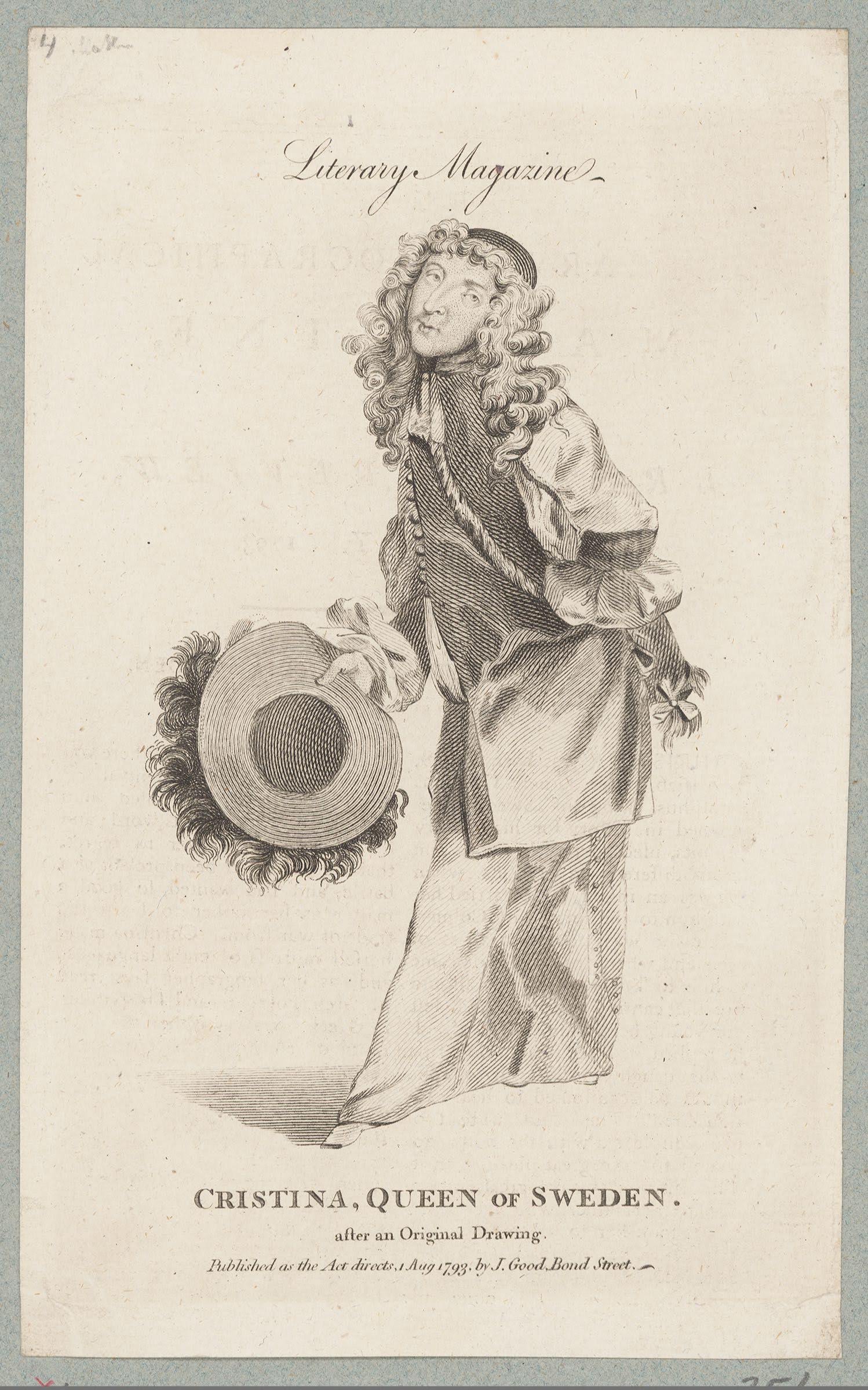
Above: Kristina.


Above: Sir Edward Hyde, 1st Earl of Clarendon.


Above: Sir Edward Nicholas.

Excerpt from Sir Edward Hyde's letter to secretary Sir Edward Nicholas, dated April 16/26 (New Style), 1650

Source:

State Papers Collected by Edward, Earl of Clarendon, volume 3, page 18, published by The Clarendon Printing House, 1786


The letter excerpt:

Dear Mr. Secretary,
... I have seen from other hands, though you write me nothing of it, that the King hath received an invitation from the Queen of Sweden to come thither; if that should prove so, much might follow; send me word what you know of it. ...
Dear Mr. Secretary,
Your own most affectionate humble Servant.
Madrid, this 26th of April, 1650.

French translation (my own):

Monsieur, le cher secrétaire,
... J'ai vu d'autres mains, bien que vous ne m'en écriviez rien, que le roi a reçu une invitation de la reine de Suède à y venir; si cela s’avérait vrai, beaucoup de choses pourraient s'ensuivre; faites-moi savoir ce que vous en savez. ...
Monsieur le cher secrétaire,
Votre humble serviteur le plus affectueux.
Madrid, ce 26 avril 1650.

Swedish translation (my own):

Käre herr sekreterare,
... Jag har sett från andra händer, fastän Ni inte skriver mig något därom, att konungen fått en inbjudan från Sveriges drottning att komma dit; om det skulle visa sig sant, kan mycket följa; sänd mig vad Ni vet om det. ...
Käre herr sekreterare,
Er egen mest tillgivne, ödmjuke tjänare.
Madrid, den 26 april 1650.


Above: Kristina.


Above: King Charles II of England.


Above: Sir Edward Hyde, 1st Earl of Clarendon.


Above: Sir Edward Nicholas.

Sunday, August 18, 2024

Excerpt from Sir Edward Hyde's letter to secretary Sir Edward Nicholas, dated April 21/May 1 (New Style), 1654

Source:

State Papers Collected by Edward, Earl of Clarendon, volume 3, page 236, published by The Clarendon Printing House, 1786


The letter excerpt:

Dear Mr. Secretary,
... It seems the good Queen of Sweden means to engage her successor not to be idle, that she begins a war at her giving over the world, which is an excellent method of devotion. I cannot wonder enough at Sir William Ballentine's silence, which keeps me totally ignorant of what is done there. ... I am with my whole heart
Dear Mr. Secretary, Your own, &c.
Paris, this 1st of May, 1654.

French translation (my own):

Monsieur, le cher secrétaire,
... Il semble que la bonne reine de Suède veuille engager son successeur à ne pas rester oisif, qu'elle commence une guerre en donnant le monde, ce qui est une excellente méthode de dévotion. Je ne saurais trop m'étonner du silence du sieur Guillaume Ballentine, qui me maintient totalement dans l'ignorance de ce qui s'y fait. ... Je suis de tout mon cœur,
Monsieur le cher secrétaire, votre, etc.
Paris, ce 1er mai 1654.

Swedish translation (my own):

Käre herr sekreterare,
... Det tycks som den goda drottningen av Sverige menar att engagera sin efterträdare för att inte vara sysslolös, att hon börjar ett krig när hon ger över världen, vilket är en utmärkt metod för devotion. Jag kan inte förundras nog över herr William Ballentines tystnad, som håller mig totalt okunnig om vad som görs där. ... Jag är med hela mitt hjärta,
Käre herr sekreterare, Er egen osv.
Paris, den 1 maj 1654.


Above: Kristina.


Above: Karl Gustav.


Above: Sir Edward Hyde, 1st Earl of Clarendon.


Above: Sir Edward Nicholas.

Excerpt from Sir Edward Hyde's letter to secretary Sir Edward Nicholas, dated January 27/February 6 (New Style), 1654

Source:

State Papers Collected by Edward, Earl of Clarendon, volume 3, page 216, published by The Clarendon Printing House, 1786


The letter excerpt:

Dear Mr. Secretary,
... We have heard that wild discourse you mention concerning the Queen of Sweden, but I conceive it can have no sober foundation. ... I am
Dear Mr. Secretary, Your own, &c.
Paris, this 6th of Feb. 1653-4.

French translation (my own):

Monsieur, le cher secrétaire,
... Nous avons entendu ce discours insensé dont vous parlez à propos de la reine de Suède, mais je crois qu'il ne peut avoir aucun fondement sérieux. ... Je suis
Monsieur le cher secrétaire, votre, etc.
Paris, ce 6 février 1654.

Swedish translation (my own):

Käre herr sekreterare,
... Vi har hört den vilda diskursen Ni nämner om Sveriges drottning, men jag tror att den inte kan ha någon allvarlig grund. ... Jag är
Käre herr sekreterare, Er egen osv.
Paris, den 6 februari 1654.


Above: Kristina.


Above: Sir Edward Hyde, 1st Earl of Clarendon.


Above: Sir Edward Nicholas.

Excerpt from Sir Edward Hyde's letter to secretary Sir Edward Nicholas, dated May 6/16 (New Style), 1653

Source:

State Papers Collected by Edward, Earl of Clarendon, volume 3, page 166, published by The Clarendon Printing House, 1786


The letter excerpt:

Dear Mr. Secretary,
... I think I have told you in some former letter that Sir Wil. Ballendine is going into Sweden about his private business (that's the ground and pretence) but he hath a letter from the King to that Queen to be delivered at discretion. The King and most other men have a great opinion of him, and I must confess upon conference with him of all old matters I am very well satisfied with him and take him to be a very honest, able man: I know he will wait on you, and I am confident he will be very free with you and I pray be so with him. We shall from him shortly know the true temper of that Queen and Court, and it is possible this great revolution in England may make some alterations likewise abroad. ... God preserve you. I am
Dear Mr. Secretary, Your own, &c.
Paris, this 16th of May, 1653.

French translation (my own):

Monsieur, le cher secrétaire,
... Je pense vous avoir dit dans une lettre précédente que le sieur Guillaume Ballentine se rend en Suède pour ses affaires privées (c'est le motif et le prétexte de cela), mais il a une lettre du roi à cette reine à remettre à discrétion. Le roi et la plupart des autres hommes ont une grande opinion de lui, et je dois avouer, après avoir discuté avec lui de toutes les vieilles questions, que je suis très satisfait de lui et que je le considère comme un homme très honnête et compétent. Je sais qu'il vous attendra, et je suis sûr qu'il sera très libre avec vous, et je vous prie de l'être avec lui. Grâce à lui, nous connaîtrons bientôt le véritable caractère de cette reine et de cette cour, et il est possible que cette grande révolution en Angleterre puisse aussi apporter quelques changements à l'étranger. ... Dieu vous conserve. Je suis
Monsieur le cher secrétaire, votre, etc.
Paris, ce 16 mai 1653.

Swedish translation (my own):

Käre herr sekreterare,
... Jag tror att jag har berättat för Er i något tidigare brev att herr William Ballentine skall resa till Sverige om sina privata affärer (det är grunden och påståendet om det), men han har ett brev från konungen till den drottningen som skall överlämnas efter gottfinnande. Konungen och de flesta andra män har en stor uppfattning om honom, och jag måste vid konferensen med honom erkänna alla gamla saker att jag är mycket nöjd med honom och anser honom vara en mycket ärlig, duktig man; jag vet att han kommer att vänta på Er, och jag är övertygad om att han kommer att vara mycket fri med Er, och jag ber Er att vara det med honom. Vi kommer snart att få veta av honom det sanna humöret hos den drottningen och hovet, och det är möjligt att denna stora revolution i England kan göra några förändringar också utomlands. ... Gud bevare Er. Jag är
Käre herr sekreterare, Er egen osv.
Paris, den 16 maj 1653.


Above: Kristina.


Above: Sir Edward Hyde, 1st Earl of Clarendon.


Above: Sir Edward Nicholas.

Excerpt from Sir Edward Hyde's letter to secretary Sir Edward Nicholas, dated March 25/April 4 (New Style), 1653

Source:

State Papers Collected by Edward, Earl of Clarendon, volume 3, page 156, published by The Clarendon Printing House, 1786


The letter excerpt:

Dear Mr. Secretary,
... If your friends at Westminster did not intend to gratify the Queen of Sweden in all she proposes they would not send away my good Lord Lisle to her. I believe there will be an honest Gentleman with you shortly, Sir Will. Balendine, who is going on his own business to Sweden who shall carry with him some directions, and we shall then have a better account of the affairs there. He once had good interest in that Queen. ...
Dear Mr. Secretary, Your own, &c.
Palace Royal, this 4th of Apr. 1653.

French translation (my own):

Monsieur, le cher secrétaire,
... Si vos amis à Westminster n'avaient pas l'intention de satisfaire la reine de Suède dans tout ce qu'elle propose, ils ne lui renverraient pas mon bon seigneur Lisle. Je crois qu'il y aura bientôt avec vous un honnête gentleman, le sieur Guillaume Ballentine, qui part pour ses propres affaires en Suède et qui vous accompagnera avec quelques instructions, et nous aurons alors un meilleur compte rendu des affaires là-bas. Il s'intéressait autrefois beaucoup à cette reine. ...
Monsieur le cher secrétaire, votre, etc.
Palais Royal, ce 4 avril 1653.

Swedish translation (my own):

Käre herr sekreterare,
... Om Era vänner i Westminster inte hade för avsikt att tillfredsställa drottningen av Sverige med allt hon föreslår, skulle de inte skicka iväg min gode herr Lisle till henne. Jag tror att det snart kommer att finnas en ärlig herre med Er, herr William Ballentine, som går i egen affär till Sverige och som skall ha med sig några instruktioner, och vi skall då få en bättre redogörelse för affärerna där. Han hade en gång ett gott intresse för den drottningen. ...
Käre herr sekreterare, Er egen osv.
Palace Royal, den 4 april 1653.


Above: Kristina.


Above: Sir Edward Hyde, 1st Earl of Clarendon.


Above: Sir Edward Nicholas.

Note: Lord Lisle = Daniel Lisle.

Excerpt from Sir Edward Hyde's letter to secretary Sir Edward Nicholas, dated November 6/16 (New Style), 1652

Source:

State Papers Collected by Edward, Earl of Clarendon, volume 3, page 115, published by The Clarendon Printing House, 1786


The letter excerpt:

Dear Mr. Secretary,
... I am very glad you have so good an opinion of Sir Alex. Hume; indeed I think you have reason, for he is an honest and intelligent gentleman, I will write to him as you direct. I do believe you have some common friend, whose name I will not enquire, for he sends me word the very same relation upon the matter of the Queen of Sweden of which you are to take no notice, but for the matter itself I am exceedingly sorry, as that which is wonderfully mischievous to us; and what remedy to apply to it I cannot imagine, this people (who alone could set that right) being neither awake to ours nor their own business. ...
Dear Mr. Secretary, Your own, &c.
Paris, this 16th of Nov. 1652.

French translation (my own):

Monsieur, le cher secrétaire,
... Je suis très heureux que vous ayez une si bonne opinion de Sir Alexandre Hume; en effet, je pense que vous avez raison, car c'est un gentilhomme honnête et intelligent, je lui écrirai selon vos instructions. Je crois que vous avez un ami commun, dont je ne demanderai pas le nom, car il m'envoie exactement le même rapport sur l'affaire de la reine de Suède dont vous ne devez pas tenir compte, mais pour l'affaire elle-même, je suis extrêmement fâché, comme cela qui nous est étrangement nuisible; et quel remède y appliquer, je ne l'imagine pas, ce peuple (qui seul pouvait y remédier) n'étant ni conscient des nôtres ni de ses propres affaires. ...
Monsieur le cher secrétaire, votre, etc.
Paris, ce 16 novembre 1652.

Swedish translation (my own):

Käre herr sekreterare,
... Jag är mycket glad att Ni har en så bra åsikt om herr Alexander Hume; jag tror verkligen att Ni har anledning, för han är en ärlig och intelligent herre, jag kommer att skriva till honom som Ni leder. Jag tror visserligen att Ni har någon gemensam vän, vars namn jag inte kommer att fråga efter, ty han sänder mig samma redogörelse i frågan om Sveriges drottning, som Ni inte skall ta hänsyn till, men för själva saken är jag ytterst ledsen, som det som är märkligt skadligt för oss; och vilket botemedel man kan tillämpa på det kan jag inte föreställa mig, det här folket (som ensam kunde sätta den rätten) varken är vaken för våra eller sina egna angelägenheter. ...
Käre herr sekreterare, Er egen osv.
Paris, den 16 november 1652.


Above: Kristina.


Above: Sir Edward Hyde, 1st Earl of Clarendon.


Above: Sir Edward Nicholas.

Note: "The Secretary had informed him 'That the Queen of Sweden had ordered Salmasius [Saumaise] not to reply to Milton's last Book. That she was of late much inclined to the Rebels, which some say is because having named a Successor, she despairs of ever having the King for a Husband; and others say this averseness hath been wrought by some ill Scotchmen there, and by means of old Oxensteirn.'"

Saturday, February 17, 2024

Excerpt from Elizabeth Stuart, Queen of Bohemia's letter to Sir Edward Nicholas, dated October 1/11 (New Style), 1655

Source:

Archaeologia, or, miscellaneous tracts relating to antiquity, volume 37, part 1, page 234, published by the Society of Antiquaries of London, 1857
The letter excerpt:

Mr Secretarie, ... There is heere little news, onelie our States are not at all pleased with the Suedes victorie. They are iustlie punished for assisting the Queene of Sueden against my Uncle. ... I ame ever
Your most affectionat frend,
E R
Hagh, Oct. 11.

With modernised spelling:

Mr. Secretary,
... There is here little news, only our States are not at all pleased with the Swedes' victory. They are justly punished for assisting the Queen of Sweden against my Uncle. ... I am ever
your most affectionate friend,
E. R.
Haag, October 11.

French translation (my own):

Monsieur le secrétaire,
... Il y a peu de nouvelles ici, si ce n'est que nos États ne sont pas du tout satisfaits de la victoire suédoise. Ils sont justement punis pour avoir aidé la reine de Suède contre mon Oncle. ... Je suis toujours
votre très affectionnée ami
E. R.
La Haye, le 11 octobre.

Czech translation (my own):

Pane sekretáři,
... Je zde málo zpráv, pouze to, že naše Státy nejsou vůbec potěšeny vítězstvím Švédů. Jsou spravedlivě potrestáni za pomoc švédské královně proti mému Strýci. ... Jsem vždy
vaše nejmilejší přítelkyně
E. R.
Haag, 11. října.

Swedish translation (my own):

Min herr sekreterare,
... Det finns här få nyheter, bara att våra Stater är inte alls nöjda med svenskarnas seger. De straffas med rätta för att ha hjälpt Sveriges drottning mot min Morbror. ... Jag är alltid
Er tillgivnaste vän
E. R.
Haag, den 11 oktober.


Above: Kristina.


Above: Elizabeth, Queen of Bohemia.


Above: Sir Edward Nicholas.

Note: Elizabeth's uncle was her maternal uncle, King Christian IV of Denmark. His older sister and Elizabeth's mother was Anne of Denmark, who was queen consort of England and Scotland by her marriage to King James I and VI.

Excerpt from Elizabeth Stuart, Queen of Bohemia's letter to Sir Edward Nicholas, dated April 16/26 (New Style), 1655

Source:

Archaeologia, or, miscellaneous tracts relating to antiquity, volume 37, part 1, page 225, published by the Society of Antiquaries of London, 1857
The letter excerpt:

Hagh, April 26.
Mr Secretarie, ... The peace betwixt France and Cromwell is much talked of heere; but I hope the Marquis de Leide, Ambass:re from the King of Spaine, will hinder it. They say he goes this next week, verie well accompanied, and it is reported that both the Queene of Sueden and the Prince of Condé sends with him to Cromwell; but I cannot assure you of the truth of it. Queen Mother of Sueden is dead, her daughter seemes much troubled at it, which makes her rap out with manie an oath. ...
Your most affectionat frend,
E R

With modernised spelling:

Haag, April 26.
Mr. Secretary,
... The peace betwixt France and Cromwell is much talked of here; but I hope the Marquis de Leyde, ambassador from the King of Spain, will hinder it. They say he goes this next week, very well-accompanied, and it is reported that both the Queen of Sweden and the Prince of Condé sends with him to Cromwell; but I cannot assure you of the truth of it. Queen Mother of Sweden is dead, her daughter seems much troubled at it, which makes her rap out with many an oath. ...
Your most affectionate friend,
E. R.

French translation (my own):

La Haye, le 26 avril.
Monsieur le secrétaire,
... On parle beaucoup ici de la paix entre la France et Cromwell; mais j'espère que le marquis de Leyde, ambassadeur du roi d'Espagne, l'en empêchera. L'on dit qu'il s'en va la semaine prochaine, très bien accompagné, et l'on rapporte que la reine de Suède et le prince de Condé l'envoient avec lui à Cromwell; mais je ne peux pas vous en assurer la vérité. La reine-mère de Suède est morte, sa fille en paraît très troublée, ce qui lui fait crier maints serments. ...
Votre très affectionnée amie
E. R.

Czech translation (my own):

Haag, 26. dubna.
Pane sekretáři,
... O míru mezi Francií a Cromwellem se zde hodně mluví; ale doufám, že markýz de Leyde, velvyslanec španělského krále, tomu bude bránit. Člověk říká, že jde příští týden, s velmi dobrým doprovodem, a je hlášeno, že švédská královna i princ z Condé s ním posílají do Cromwellu; ale nemohu vás ujistit o pravdě. Královna matka Švédska je mrtvá, zdá se, že její dcera je z toho velmi znepokojená, což ji nutí vykřiknout mnoho přísah. ...
Vaše nejmilejší přítelkyně
E. R.

Swedish translation (my own):

Haag, den 26 april.
Min herr sekreterare,
... Freden mellan Frankrike och Cromwell är mycket omtalad här; men jag hoppas att markisen de Leyde, ambassadören från konungen av Spanien, kommer att hindra det. Man säger att han går denna nästa vecka, mycket välledsagad, och det rapporteras att både drottningen av Sverige och prinsen de Condé skickar med honom till Cromwell; men jag kan inte försäkra Er om sanningen i det. Sveriges drottningmodern är död, hennes dotter verkar mycket uppriven över det, vilket får henne att ropa ut många ed. ...
Er tillgivnaste vän
E. R.


Above: Kristina.


Above: The Prince de Condé.


Above: Maria Eleonora.


Above: Elizabeth Stuart, Queen of Bohemia.


Above: Sir Edward Nicholas.

Note: "The enmity that at this time existed between Elizabeth and Christina of Sweden is well known."

Excerpt from Elizabeth Stuart, Queen of Bohemia's letter to Sir Edward Nicholas, dated January 8/18 (New Style), 1655

Source:

Memoirs of John Evelyn, volume 2, pages 218 to 219, published by William Bray, 1827
The letter excerpt:

Mr. Secretarie, ... As for the Archduc he may thanke God to be ridd of the Queen of Sueden, who is lodged at the Count of Egmonts house in Bruxelles, where she stays all winter. My Lord Norwich has got news that the Archduc goes for Spaine, and Don John of Austria comes in his place and marrieth the Queene of Sueden, and to haue the Low Countries as the Archduc Albert, but I beleeue it not: there is nothing else that I have to say to you but ame euer
Your most affectionate friend,
E R
Hagh, Jan. 18.

With modernised spelling:

Mr. Secretary,
... As for the Archduke, he may thank God to be rid of the Queen of Sweden, who is lodged at the Count of Egmont's house in Brussels, where she stays all winter. Milord Norwich has got news that the Archduke goes for Spain, and Don John of Austria comes in his place and marrieth the Queen of Sweden, and to have the Low Countries as the Archduke Albert, but I believe it not. There is nothing else that I have to say to you, but am ever
your most affectionate friend,
E. R.
Haag, January 18.

French translation (my own):

Monsieur le secrétaire,
... Quant à l'archiduc, il doit remercier Dieu de se débarrasser de la reine de Suède, logée chez le comte d'Egmont à Bruxelles, où elle séjourne tout l'hiver. Milord Norwich a appris que l'archiduc partait pour l'Espagne, que don Jean d'Autriche venait à sa place et épousait la reine de Suède, et qu'il voulait avoir les Pays-Bas comme archiduc Albert, mais je ne le crois pas. Je n'ai rien d'autre à vous dire, mais je suis toujours
votre très affectionnée amie
E. R.
La Haye, le 18 janvier.

Czech translation (my own; I cannot tag it as such due to character limits in the tags):

Pane sekretáři,
... Pokud jde o arcivévodu, ten musí děkovat Bohu, že se zbavil švédské královny, která je ubytována v domě hraběte z Egmontu v Bruselu, kde zůstává celou zimu. Milord Norwich má zprávu, že arcivévoda jede do Španělska a don Jan Rakouský přichází místo něj a ožení se s královnou Švédska a chce mít Dolní země jako arcivévodu Alberta, ale já tomu nevěřím. Nemám nic jiného, ​​co bych vám měla říct, ale vždy jsem vaše nejmilejší přítelkyně
E. R.
Haag, 18. ledna.

Swedish translation (my own):

Min herr sekreterare,
... Vad ärkehertigen angår, så måste han tacka Gud för att bli av med drottningen av Sverige, som är inkvarterad hos greven av Egmonts hus i Bryssel, där hon vistas hela vintern. Milord Norwich har fått nyheter att ärkehertigen går för Spanien, och don Juan av Österrike kommer i hans ställe och gifter sig med drottningen av Sverige, och han vill ha de låga länderna som ärkehertig Albrecht, men jag tror inte på det. Det finns inget annat som jag har att säga till Er, men jag är alltid
Er mest tillgivna vän
E. R.
Haag, den 18 februari.


Above: Kristina.


Above: Leopold Wilhelm, Archduke of Austria.


Above: Lodewijk Filips (Louis-Philippe), Count of Egmont.


Above: Juan José of Austria.


Above: Elizabeth Stuart, Queen of Bohemia.


Above: Sir Edward Nicholas.

Excerpt from Elizabeth Stuart, Queen of Bohemia's letter to Sir Edward Nicholas, dated January 1/11 (New Style), 1655

Source:

Memoirs of John Evelyn, volume 2, pages 216 to 217, published by William Bray, 1827
The letter excerpt:

Hagh, Jan. 11 (1654-5).
Mr. Secretarie, ... the queene of Sueden takes a house at Anwerp, all her owne people leaues her and Italiens and Spaniards come in theire place. ...
your most affectionat frend. ...

With modernised spelling:

Haag, January 11 [1654-5].
Mr. Secretary,
... The Queen of Sweden takes a house at Antwerp, all her own people leaves her and Italians and Spaniards come in their place. ...
your most affectionate friend. ...

French translation (my own):

La Haye, le 11 janvier [1654-5].
Monsieur le secrétaire,
... La reine de Suède prend une maison à Anvers, tous les siens la quittent et des Italiens et des Espagnols viennent à leur place. ...
votre très affectionnée amie.

Czech translation (my own):

Haag, 11. ledna [1654-5].
Pane sekretáři,
... Královna Švédska zůstává v domě v Antverpách, všichni její vlastní lidé ji opouštějí a místo nich přicházejí Italové a Španělé. ...
vaše nejmilejší přítelkyně.

Swedish translation (my own):

Haag, den 11 januari [1654-5].
Min herr sekreterare,
... Drottningen av Sverige tar hus i Antwerpen, allt hennes eget folk lämnar henne och italienare och spanjorer kommer i deras ställe. ...
Er tillgivnaste vän.


Above: Kristina.


Above: Elizabeth Stuart, Queen of Bohemia.


Above: Sir Edward Nicholas.

Excerpt from Elizabeth Stuart, Queen of Bohemia's letter to Sir Edward Nicholas, dated December 25, 1654/January 4, 1655 (New Style)

Source:

Memoirs of John Evelyn, volume 2, pages 212 to 214, published by William Bray, 1827
The letter excerpt:

Hagh Jan: 4 (1654-5).
Mr. Secretarie, ... We heare no certaintie heere how the French treatie with the rebells in England goes, whither it breake or peece. ... the Queene of Sueden is now at Bruxelles, where she was receaued in greate state: I beleeue the Arch-duke wisheth her at Anwerp, for she persecutes him verie close with her companie, for you know he is a verie modest man. I haue written to the King some particullars of it which are verie rare ons, but the Prince of Condé is still verie unsatisfied with her and will not come at her. ...
your most affectionat frend.

With modernised spelling:

Haag, January 4 [1654-5].
Mr. Secretary,
... We hear no certainty here how the French treaty with the rebels in England goes, whether it break or peace. ... The Queen of Sweden is now at Brussels, where she was received in great state; I believe the Archduke wisheth her at Antwerp, for she persecutes him very close with her company, for you know he is a very modest man. I have written to the King some particulars of it which are very rare ones, but the Prince of Condé is still very unsatisfied with her and will not come at her. ...
your most affectionate friend.

French translation (my own):

La Haye, le 4 janvier [1654-5].
Monsieur le secrétaire,
... Nous ne savons pas avec certitude comment se déroulera le traité français avec les rebelles en Angleterre, s'il sera rompu ou si la paix sera rétablie. ... La reine de Suède est maintenant à Bruxelles, où elle a été reçue en grand état; je crois que l'Archiduc aimerait qu'elle soit à Anvers, car elle le persécute de très près avec sa compagnie, car vous savez que c'est un homme très modeste. J'en ai écrit au roi quelques détails qui sont très rares, mais le prince de Condé est encore très mécontent d'elle et ne veut pas venir la voir. ...
votre très affectionnée amie.

Czech translation (my own; I cannot tag it as such due to character limits in the tags):

Haag, 4. ledna [1654-5].
Pane sekretáři,
... Tady neslyšíme žádnou jistotu, jak probíhá francouzská smlouva s rebely v Anglii, jestli je porušena nebo jestli je mír. ... Královna Švédska je nyní v Bruselu, kde byla přijata ve skvělém stavu; věřím, že si arcivévoda přeje, aby byla v Antverpách, protože ho velmi úzce pronásleduje se svou společností, protože víte, že je to velmi skromný muž. Napsala jsem králi několik podrobností, které jsou velmi vzácné, ale princ z Condé je s ní stále velmi nespokojený a nechce ji navštívit. ...
vaše nejmilejší přítelkyně.

Swedish translation (my own):

Haag, den 4 january [1654-5].
Min herr sekreterare,
... Vi hör ingen visshet här hur det franska fördraget med rebellerna i England går, om det är brutet eller om det råder fred. ... Drottningen av Sverige befinner sig nu i Bryssel, där hon togs emot i stor stat; jag tror att ärkehertigen önskar att hon var i Antwerpen, ty hon förföljer honom mycket nära med sitt sällskap, för Ni vet att han är ju en mycket blygsam man. Jag har skrivit till kungen några detaljer om det som är mycket sällsynta, men prinsen av Condé är fortfarande mycket missnöjd med henne och vill inte komma och träffa henne. ...
Er tillgivnaste vän.


Above: Kristina.


Above: Leopold Wilhelm, Archduke of Austria.


Above: The Prince de Condé.


Above: Elizabeth Stuart, Queen of Bohemia.


Above: Sir Edward Nicholas.

Note: "In January the cavaliers were stirring, but in vain; and in the following November, Cromwell made peace with the French. The Ex-Queen of Sweden and the Prince of Condé seem to have been meddling with those affairs, through the diplomatic exertions of the Count de Tott; as may be seen by reference to a letter in Bromley's Collection, p. 186."

Excerpt from Elizabeth Stuart, Queen of Bohemia's letter to Sir Edward Nicholas, dated December 11/21 (New Style), 1654

Source:

Memoirs of John Evelyn, volume 2, pages 208 to 210, published by William Bray, 1827
The letter excerpt:

Hagh De: 21. (1654.)
Mr Secretarie, ... The French Ambassadour beleeues the treatie with Cromwell as good as broken; he is much ioyed that the meeting betwixt the Queene of Sueden and P. of Condé was to neither of theire content, for he desired to be receaued as the Queene receaued the Arcdduc, which she refused, saying that she had done too much for in that and woulde doe so no more, yet he came to see her brusquement a l'improuist, and did nothing but railler her in his talke, which putt her so out as she said almost not one worde. This was in the morning; after dinner she sent to know if he woulde see the play at night, he said he would obey her, but desired to know whither he shoulde come knowen or as vnknowen, for if he came as Prince of Condé he looked tohaue a chaise a bras as the Archduc had — she saide he had better come unknowen, so he came, and she stood all the play, railling with Monr Quito the Princes favourit. the next day the P. went to Bruxelles, and neither of them well satisfied with the other. ... I thank you for your congratulation of Apollos returne, you know how great a favorit he is to
Your most affectionat frend. ...

With modernised spelling:

Haag, December 21 [1654].
Mr. Secretary,
... The French ambassador believes the treaty with Cromwell as good as broken; he is much joyed that the meeting betwixt the Queen of Sweden and Prince of Condé was to neither of their content, for he desired to be received as the Queen received the Archduke, which she refused, saying that she had done too much for in that and would do so no more, yet he came to see her brusquement à l'improviste and did nothing but railler her in his talk, which put her so out as she said almost not one word.

This was in the morning; after dinner she sent to know if he would see the play at night, he said he would obey her, but desired to know whether he should come known or as unknown, for if he came as Prince of Condé he looked to have a chaise à bras as the Archduke had — she said he had better come unknown, so he came, and she stood all the play, railing with Monsieur Quito, the Prince's favourite. The next day the Prince went to Brussels, and neither of them well satisfied with the other. ... I thank you for your congratulation of Apollo's return, you know how great a favourite he is to
your most affectionate friend. ...

French translation (my own):

La Haye, le 21 décembre [1654].
Monsieur le secrétaire,
... L'ambassadeur de France estime que le traité avec Cromwell est pour ainsi dire rompu; il est très heureux que la rencontre entre la reine de Suède et le prince de Condé n'ait été ni à leur contentement, car il désirait être reçu comme la reine recevait l'archiduc, ce qu'elle refusa, disant qu'elle en avait trop fait pour cela et il ne voulait plus le faire, mais il venait la voir brusquement à l'improviste et ne faisait que la railler dans son discours, qui l'offensait tellement qu'elle ne disait presque pas un mot.

C'était le matin; après le dîner, elle fit savoir s'il voulait voir la pièce le soir, il dit qu'il lui obéirait, mais il désirait savoir s'il devait se montrer connu ou inconnu, car s'il venait en prince de Condé, il demanderait à avoir une chaise à bras comme l'archiduc en avait — elle dit qu'il valait mieux qu'il vienne inconnu, alors il vint, et elle resta debout pendant toute la pièce, raillant avec M. Quito, le favori du prince. Le lendemain, le prince se rendit à Bruxelles, et aucun d'eux n'était très satisfait de l'autre. ... Je vous remercie pour vos félicitations pour le retour d'Apollon, vous savez bien à quel point il est le favori de
votre très affectionnée amie. ...

Czech translation (my own):

Haag, 21. prosince [1654].
Pane sekretáři,
... Francouzský velvyslanec věří, že smlouva s Cromwellem je stejně dobrá jako porušená; je velmi rád, že setkání mezi švédskou královnou a princem z Condé nebylo k jejich spokojenosti, protože si přál být přijat, jako královna přijala arcivévodu, což odmítla s tím, že pro to udělala příliš mnoho a už to nechtěl udělat, ale přišel ji vidět brusquement à l'improviste a nedělal nic jiného, ​​než že ji raillait ve svých řečech, což ji tak urazilo, že neřekla skoro ani slovo.

Bylo to ráno; po večeři poslala, aby věděla, jestli chce vidět hru v noci, řekl, že ji poslechne, ale chtěl vědět, jestli by měl být známý nebo neznámý, protože kdyby přišel jako princ z Condé, požádal by o chaise à bras jako měl arcivévoda — řekla, že by měl přijít neznámý, a tak přišel, a ona stála po celou dobu hry a zábradlí s monsieur Quito, princův oblíbenec. Druhý den princ odjel do Bruselu a ani jedno z nich nebylo s tím druhým příliš spokojeno. ... Děkuji vám za vaše blahopřání k Apollónovu návratu, víte, jak velký oblíbenec je u vaší nejmilovanější přítelkyně. ...

Swedish translation (my own):

Haag, den 21 december [1654].
Min herr sekreterare,
... Den franske ambassadören anser att fördraget med Cromwell är så gott som brutet; han är mycket glad över att mötet mellan drottningen av Sverige och prinsen av Condé inte var till något av deras belåtenhet, ty han önskade att bli mottagen som drottningen tog emot ärkehertigen, vilket hon vägrade och sade att hon hade gjort för mycket för i det och ville inte göra det mer, men ändå kom han för att se henne brusquement à l'improviste och gjorde inget annat än railler henne i sitt tal, vilket kränkte henne så mycket att hon nästan inte sade ett ord.

Detta var på morgonen; efter middagen skickade hon för att veta om han ville se pjäsen på natten, han sade att han skulle lyda henne, men han ville veta om han skulle bli känd eller okänd, för om han kom som prinsen av Condé skulle han be om att få ha en chaise à bras som ärkehertigen hade — hon sade att det var bäst att han hade kommit okänd, så han kom, och hon stod under hela pjäsen och raljerade med monsieur Quito, prinsens favorit. Dagen efter reste prinsen till Bryssel, och ingen av dem var väl tillfreds med den andra. ... Jag tackar Er gratulation till Apollos återkomst, Ni vet väl hur stor favorit han är för
Er tillgivnaste vän. ...


Above: Kristina.


Above: The Prince de Condé.


Above: Elizabeth Stuart, Queen of Bohemia.


Above: Sir Edward Nicholas.

Notes: "Yet the Prince de Condé was a great admirer of Christina, and observed upon one occasion — 'How great is the magnanimity of this Princess, who could so easily give up that for which mankind are continually destroying each other, and which so many throughout their whole lives pursue without attaining!' Condé, at the period here recorded, was in exile at Brussells; and though he felt offended upon the score of etiquette, her abdicated Majesty seems to have treated him with great familiarity, exclaiming 'Cousin! who would have thought ten years ago that we should have met at this distance from our countries?' The Prince might have thanked her for his exile, as it arose partly from her intermeddling in the affairs of the Fronde in France, a few years previous."

Apollo = Elizabeth's lapdog.

Excerpt from Elizabeth Stuart, Queen of Bohemia's letter to Sir Edward Nicholas, dated November 23/December 3 (New Style), 1654

Sources:

Memoirs of John Evelyn, volume 2, pages 206 to 207, published by William Bray, 1827
The Sibyl of the North: The Tale of Christina, Queen of Sweden, page 117, by Faith Compton Mackenzie, 1931


The letter excerpt:

Hagh De: 3 (1654.)
Mr. Secretarie, I receaued yours at Berghen, whither I was come from Anwerp and Bruxells. I finde you haue vnridled my riddle verie right. I saw the Queene of Sueden at the play, she is extrauagant in her fashion and aparell, but she has a good well fauoured face, and a milde countenance. One of the players that knew me tolde her who I was, but she made no shew of it. ... I stayed but Sunday at Bruxelles, and returned to Anwerp vpon Munday, and heearing from Duart how the Queene of Sueden had desired to know when I came back thither, that she might meet with me in an indifferent place, I made the more hast away the next day because I had no minde to speak with her since I heard how unhandsomlie she had spoken of the King my deare Brother and of the King my deare Nephue, and indeed of all our nation, so I auoided it and went away as soone as I had dined. Yett she sent Donoy to me with a verie civill message that she was sorie she coulde not use that ciuilitie to me as she both should doe and desired, hoping that one day wee might meet together with more freedome; I answered her as civillie as I coulde, and now when I went from Berghen I gaue Sr Will: Swann charge to make her a complement from me. ... it is so colde as I can say no more, but ame euer
Your most affectionat frend. ...

With modernised spelling:

Haag, December 3 [1654].
Mr. Secretary,
I received yours at Bergen, whither I was come from Antwerp and Brussels. I find you have unriddled my riddle very right. I saw the Queen of Sweden at the play, she is extravagant in her fashion and apparel, but she has a good, well-favoured face and a mild countenance. One of the players that knew me told her who I was, but she made no show of it. ...

I stayed but Sunday at Brussels, and returned to Antwerp upon Monday, and hearing from Duart how the Queen of Sweden had desired to know when I came back thither, that she might meet with me in an indifferent place, I made the more haste away the next day because I had no mind to speak with her, since I heard how unhandsomely she had spoken of the King my dear Brother and of the King my dear Nephew, and indeed of all our nation, so I avoided it and went away as soon as I had dined.

Yet she sent Donoy to me with a very civil message that she was sorry she could not use that civility to me as she both should do and desired, hoping that one day we might meet together with more freedom; I answered her as civilly as I could, and now when I went from Bergen I gave Sir William Swann charge to make her a compliment from me. ... It is so cold as I can say no more, but am ever
your most affectionate friend. ...

French translation (my own):

La Haye, le 3 décembre [1654].
Monsieur le secrétaire,
J'ai reçu votre lettre à Bergen, d'où j'étais venu d'Anvers et de Bruxelles. Je vois que vous avez très bien résolu mon énigme. J'ai vu la reine de Suède à la pièce, elle est extravagante dans sa mode et son habillement, mais elle a un bon visage bien favorisé et une coutenance douce. Une des joueuses qui me connaissait lui a dit qui j'étais, mais elle n'en a pas fait d'histoires. ...

Je ne restai que dimanche à Bruxelles et revins à Anvers lundi, et lorsque j'appris par Duart comment la reine de Suède avait désiré savoir quand j'y reviendrais afin qu'elle puisse me rencontrer dans un endroit indifférent, je me hâtai d'autant plus partir le lendemain parce que je ne voulais pas lui parler, car j'avais entendu avec quelle méchanceté elle avait parlé du roi mon cher Frère et du roi mon cher Neveu, et même de toute notre nation, alors je l'ai évité et je partis aussitôt que j'eus dîné.

Pourtant, elle m'a envoyé Donoy avec un message très civil disant qu'elle regrettait de ne pas pouvoir utiliser cette civilité avec moi comme elle devrait le faire et le désirait, espérant qu'un jour nous pourrions nous rencontrer avec plus de liberté; je lui ai répondu aussi civilement que possible, et maintenant, quand je suis parti de Bergen, j'ai chargé sir Guillaume Swann de lui faire un compliment de ma part. ... Il fait si froid que je ne peux pas en dire plus, mais je suis toujours
votre très affectionnée amie. ...

Czech translation (my own):

Haag, 3. prosince [1654].
Pane sekretáři,
Váš dopis jsem obdržela v Bergenu, kam jsem přijela z Antverp a Bruselu. Vidím, že jste mou hádanku vyřešili velmi správně. Viděla jsem švédskou královnu ve hře, je extravagantní ve své módě a oblečení, ale má dobrou, oblíbenou tvář a mírnou tvář. Jedna z hráček, která mě znala, jí řekla, kdo jsem, ale nedělala si z toho hlavu. ...

V Bruselu jsem zůstala jen v neděli a v pondělí jsem se vrátila do Antverp, a když jsem od Duarta slyšela, jak švédská královna chtěla vědět, až se tam vrátím, aby se se mnou mohla setkat na lhostejném místě, pospíšila jsem si ještě víc abych se druhý den dostala pryč, protože jsem s ní nechtěla mluvit, protože jsem slyšela, jak neslušně mluvila o králi, mém drahém Bratru, a o králi, mém drahém Synovci, a vlastně o celém našem národě, takže jsem se tomu vyhýbala a odešela, jakmile jsem se navečeřela.

Přesto mi poslala Donoye s velmi zdvořilým vzkazem, že ji mrzí, že ke mně nemůže použít takovou zdvořilost, jak by to měla dělat a jak si to přála, a doufala, že se jednoho dne setkáme společně s větší svobodou; odpověděla jsem jí tak zdvořile, jak jsem jen mohla, a teď, když jsem jela z Bergenu, dala jsem siru Williamu Swannovi pověření, aby ji ode mě pochválil. ... Je tak chladno, že už nemůžu říct víc, ale vždy jsem
vaše nejmilejší přítelkyně. ...

Swedish translation (my own):

Haag, den 3 december [1654].
Min herr sekreterare,
Jag fick Ert brev i Bergen, dit jag hade kommit från Antwerpen och Bryssel. Jag ser att Ni har löst min gåta mycket korrekt. Jag såg Sveriges drottning på pjäsen, hon är extravagant i sitt mode och kläder, men hon har ett gott, omtyckt ansikte och ett mildt ansikte. En av spelarna som kände mig berättade för henne vem jag var, men hon gjorde inget väsen av det. ...

Jag stannade bara söndagen i Bryssel och återvände till Antwerpen på måndagen, och när jag hörde av Duart hur drottningen av Sverige hade velat veta när jag kom tillbaka dit så att hon kunde träffa mig på en likgiltig plats, skyndade jag mig ännu mer att komma iväg nästa dag eftersom jag inte ville tala med henne, ty jag hörde hur elakt hon hade talat om kungen, min käre Bror och om kungen, min kära Brorson, och faktiskt om hela vårt folk, så jag undvek det och gick bort så fort jag hade ätit.

Ändå sände hon Donoy till mig med ett mycket artigt meddelande att hon var ledsen att hon inte kunde använda den artigheten mot mig som hon både borde göra och önskat, i hopp om att vi en dag skulle mötas med mer frihet; jag svarade henne så artigen jag kunde, och nu när jag reste från Bergen gav jag sir William Swann i uppdrag att ge henne en komplimang från mig. ... Det är så kallt att jag inte kan säga mer, men är alltid
Er mest tillgivna vän. ...


Above: Kristina.


Above: Elizabeth Stuart, Queen of Bohemia.


Above: Sir Edward Nicholas.